Why is Ceuta Spanish and not Moroccan? Here’s everything you need to know about Spain’s African exclave.
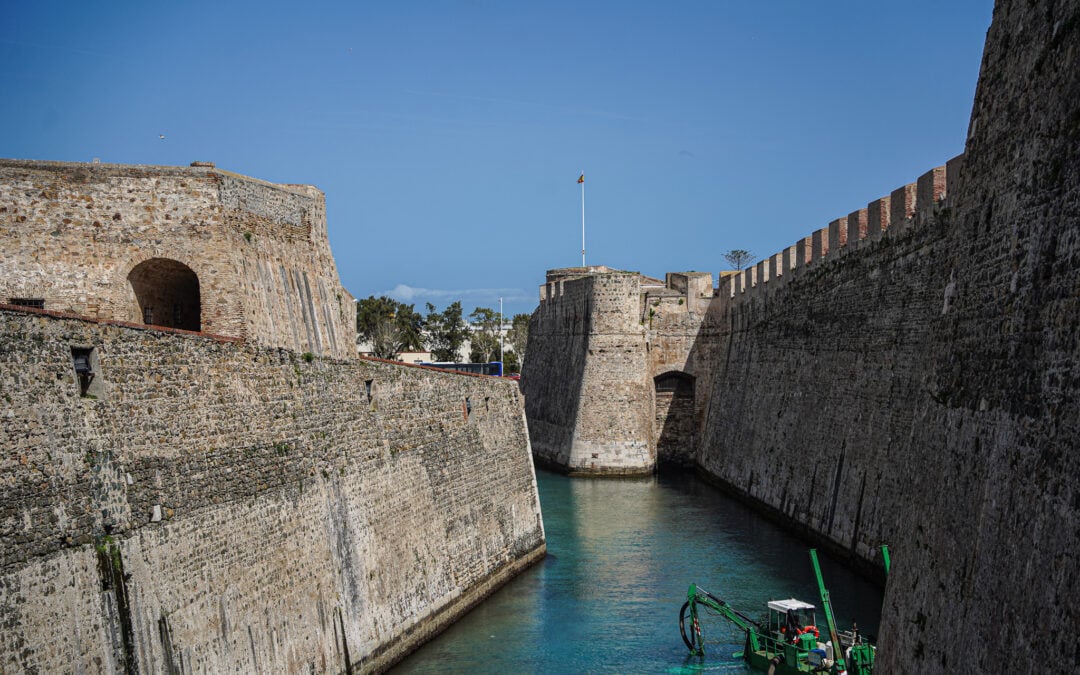
“You see the Spanish flag at the top of the citadel?” asked local tour guide Toni, who was born and raised in the Spanish exclave, as we stood outside the gates of Ceuta’s Royal Walls. “Of course, we are a Spanish city.”
As the Spanish flag flew lazily in the wind above 16th-century fortifications, Toni’s remark was a simple yet effective way to explain centuries of nuanced history and geopolitics on what’s now the European Union’s border with Africa. Ceuta, a small peninsula of land surrounded on three sides by the Mediterranean Sea, sits uneasily at the edge of two continents. Ceuta is on African soil, yet it remains resolutely Spanish.
It’s no surprise, then, that Ceuta has long been at the centre of a geopolitical standoff. To Morocco, with which it shares a heavily fortified border, Ceuta is a colonial relic. But to Spain, it’s sovereign Spanish territory, as it has been for almost 500 years. This isn’t the whole story, however.
Behind the razor wire and diplomatic friction lies a deeper history: Roman settlements, Islamic dynasties, Portuguese conquest, and a conscious decision by Ceutans to remain Spanish even after Portugal broke from Madrid in the 17th century. Today, Ceuta is home to Spanish Christians, Arabic-speaking Muslims, Hindus and Jews. It’s a layered, multicultural city with strategic importance, historic depth, and political sensitivity.
It’s also a flashpoint for violence in the EU’s migration crisis. Every week, people die trying to swim across the fortified border from Morocco, hoping to reach EU soil. “Kids, boys… they think they can make it, and they get swept out,” said one taxi driver I spoke to during my trip here.
I wanted to know more about this geopolitical anomaly, a Spanish exclave on the North African coastline. ‘Why is Ceuta Spanish?’ That’s the question I wanted to answer, as I set off across the Straits of Gibraltar.
Keep reading to find out more about Ceuta, or watch my YouTube video from the trip below.
Table of Contents
Where is Ceuta?
I’d arrived in Ceuta after a rough crossing on the Balearia ferry from Algeciras, Spain’s largest Mediterranean port. In the early morning, as the sun rose ponderously above the Rock of Gibraltar (a British Overseas Territory bordering the Spanish mainland), formidable waves shook the ferry side to side.
On board, I heard Moroccan and Spanish spoken. After crossing the Straits of Gibraltar, I’d left Europe behind to land on North African soil. But there were no passport checks. I hadn’t left the European Union, and an enormous Spanish flag in Ceuta’s harbour announced, resolutely, that we were most certainly still in Spain.
Ceuta is a small, autonomous Spanish city located on the northern tip of the African continent. It covers just 20 square kilometres. It’s bordered by Morocco to the south and east, while the rest of the peninsula is surrounded by the Mediterranean Sea. Located directly across the Strait of Gibraltar from mainland Spain, it forms one of two Spanish exclaves on African soil — the other being Melilla, which is found further east along the North African coast.
Though geographically in Africa, Ceuta is politically and legally part of Spain, and by extension, the European Union. That contradiction defines Ceuta’s uniqueness and its tensions. At the harbour, I met Toni from the local tourism office. She took me to see Ceuta’s Royal Walls, which have defended this narrow peninsula for centuries.
“The manmade moat means that the old city of Ceuta is effectively an island,” she said, as we looked up at the Spanish flag atop the gates. “From the western side of the peninsula, you can look out across the sea to Spain. On the eastern side, Morocco is just a few kilometres away. You can walk across the peninsula in a few minutes in places.”
This proximity to Morocco — and its position at the southern frontier of the EU — has made Ceuta not only a strategic outpost but also a flashpoint in Europe’s migration crisis and a focal point of a longstanding territorial dispute.

The long history of Ceuta
As we walked the Royal Walls, Toni explained how Ceuta’s history stretches back to antiquity. The Phoenicians, among the earliest seafaring civilisations in the Mediterranean, established trading outposts along the North African coast, including what is now Ceuta. Later, under Roman rule, the area became known as Septem Fratres (“Seven Brothers”), a reference to the seven surrounding hills. The city became a strategic waypoint between Roman Hispania and Mauretania.
After the fall of Rome, Ceuta experienced a series of successive rulers. The Vandals briefly held it before it was incorporated into the Byzantine Empire in the 6th century. By the early 8th century, Islamic forces had taken control, integrating Ceuta into the expanding Umayyad Caliphate. It later became part of the Caliphate of Córdoba, followed by the Almoravid and Almohad dynasties.
Under Islamic rule, Ceuta flourished as a centre of trade and scholarship. It was a maritime link between al-Andalus and North Africa, and a conduit for the transmission of knowledge, goods and people across the Islamic world. For centuries, it was governed by Muslim powers whose influence extended across the Maghreb and into Iberia.
This long Islamic chapter ended abruptly in 1415 when Portuguese forces launched a seaborne assault, part of the wider Christian Reconquista of Islamic lands. “Portuguese sailors arrived to conquer the city in 1415,” said Toni. “It wasn’t a bloody conquest.” The city fell with minimal resistance, but he conquest of Ceuta marked a turning point in European expansionism. It was one of the first overseas conquests by a European power in the Age of Discovery, preceding Vasco da Gama’s voyages and the conquest of the Americas.
Ceuta remained Portuguese for over 160 years. During this period, it served as a vital port, supplying and defending Portugal’s early colonial ventures in West Africa. In 1580, the crowns of Spain and Portugal were unified under Philip II, and Ceuta came under de facto Spanish rule. When Portugal reasserted its independence in 1640, Ceutans were given a choice: align with Lisbon or remain under Madrid. “They decided to stay with Spain,” Toni said simply. “And we’ve been Spanish ever since.”
That decision has defined Ceuta ever since. The city was formally annexed by Spain and integrated into its imperial and then national structure. Spain’s administration of Ceuta has been reinforced through military fortifications and treaties. Following the Hispano-Moroccan War of 1859–1860, Spain confirmed its hold over Ceuta in the Treaty of Wad Ras. This accord also established modern borders, which remain in place to this day, and when Morocco gained independence in 1956, Ceuta had already been Spanish for more than three centuries.

Read more: Why Pheasant Island Changes Nationalities Every Six Months
Moroccan claims over Ceuta
Toni took me to the bastions overlooking Playa de la Ribera, a sandy stretch of beach packed with sunbathers. From here, we had a view of the North African coastline stretching south into Morocco.
Morocco gained independence from France and Spain in 1956. Since then, Morocco has asserted that Ceuta and Melilla — the two Spanish-controlled cities on the North African coast — should be ‘returned’ to Moroccan sovereignty. The Moroccan government frames this as a post-colonial issue, arguing that foreign control over cities on African soil is a violation of its territorial integrity.
To Moroccan officials, its geographic location alone justifies the claim. Morocco’s foreign ministry has consistently referred to Ceuta and Melilla as “occupied cities,” drawing a parallel with the broader decolonisation movement. This claim is reiterated during moments of political tension or domestic unrest.
Toni suggested that Moroccan claims are often used for domestic political distraction, for example. “When the Moroccan government has a problem, they ask for Ceuta and Melilla,” she said. “To make people forget about the real problems.”
This tactic, though politically expedient, has done little to resolve the issue diplomatically, particularly when Morocco’s claim is based more on post-independence nationalism than any continuous historical control.
Spain’s response to Morocco’s claim over Ceuta is rooted in a mix of legal precedent, historical continuity, and local identity. Spanish officials insist that Ceuta is not a colonial possession but a fully integrated part of the Spanish state — and has been for centuries. Ceuta voluntarily aligned with Spain in the 17th century, long before the emergence of modern Moroccan nationalism.
“We had the opportunity to decide, and decided to stay with Spain,” said Toni of the 17th-century decision to align with Spain. For Spain, this moment is crucial: it proves that Ceuta’s status is not one of imposition but choice.
Spanish law treats Ceuta as an autonomous city with full representation in national institutions. It is part of the EU, uses the euro, and is governed by Spanish civil law. The local population holds Spanish citizenship, regardless of religion or ethnic background. “It doesn’t matter if you are called Muhammad or Antonia,” said Toni, of Ceuta’s multicultural society. “You are Spanish.”
Ultimately, Spain sees Morocco’s claim not as a legal dispute, but a political manoeuvre. From Spain’s perspective, Ceuta is not a colonial possession; it is part of the Spanish nation by legal continuity and popular will, and Morocco’s claim lacks recent administrative precedent. No modern Moroccan state has ever governed it. From Spain’s perspective, the Moroccan claim is grounded more in symbolism and regional influence than in international law or self-determination.

Read more: How Many Countries in Southern Europe? Everything You Need to Know.
Ceuta’s modern demographics
Ceuta might be Spanish, but as Toni had alluded to, it’s also one of Spain’s most multicultural cities. Coincidentally, I was visiting during Eid, the end of Ramadan. Here in Ceuta, the Islamic event is celebrated as a public holiday. When the event was first proscribed officially in 2010, it was the first time a non-Christian holiday had been publicly celebrated in Spain since the Reconquista five centuries earlier.
Ceuta is home to roughly 83,000 residents, and its population is almost evenly split between Christians and Muslims—about 50% Catholic and around 48% Muslim—alongside small Jewish and Hindu communities. Arabic (Darija) is widely spoken in daily life, but Spanish is the official language of government, education, and public administration.
Despite its religious and ethnic diversity, Ceuta remains firmly aligned with the Spanish national identity. It is, in many ways, though, a bastion of Spanish nationalism, intensified by its location on Europe’s southern frontier. This nationalist sentiment is politically represented by Vox, the radical-right party known for its strong anti-immigration and centralist positions. In the 2023 regional elections, Vox secured nearly 32% of the vote, outperforming all other parties and demonstrating deep local support for its vision of Spain’s identity and sovereignty.
Vox has leveraged Ceuta’s demographic complexity to frame migration—particularly from sub-Saharan Africa and Morocco—as a threat to Spanish identity. Its rhetoric portrays Ceuta as under siege and emphasises strong border controls, including the building of an “impassable wall”. In social media coverage of migration crises, Vox consistently shaped the narratives, mobilising public sentiment around cultural preservation and national sovereignty.

Read more: How Many Countries in Western Europe? Everything You Need to Know.
Barbed wire and watchtowers on ‘La Frontera’
I wanted to see ‘La Frontera’, the most contested border in Spain. A place of razor and watchtowers that defines not just Ceuta, but the European Union’s southern boundary with Africa.
Standing on the beach at Benzú, at the very edge of Ceuta, the border with Morocco is impossible to ignore. A high, reinforced fence snakes its way across the sand and into the Mediterranean Sea, separating two worlds with wire, concrete, and guard towers.
Locals know the tragic stories that define this stretch of shoreline. Jesus, a Ceutan taxi driver who’d driven me to the border, gestured toward the water. “They try and swim across… kids, boys, think they can make it, and they get swept out,” he said, describing the grim reality of this border. “Every week, several people die trying to swim across from Morocco to Spain.”
While the beach appears calm, its tranquillity belies a deeper crisis. Ceuta, as an EU territory on African soil, has become a flashpoint in Europe’s migration tensions. Sub-Saharan migrants and asylum seekers gather on the Moroccan side, hoping to cross into EU territory. Some attempt to climb the fence. Others swim. In July 2025, 54 minors were reported to have swum across. The stakes are high, and the Spanish authorities are under pressure to defend the EU’s external border — often forcefully, which results in tragedies.
On this quiet day, it was Eid, and no crossings were being attempted. But the infrastructure — barbed wire, surveillance towers, patrol vehicles — remains a stark reminder that Ceuta is more than a city. It is a frontline, both symbolically and physically, in one of Europe’s most enduring and divisive challenges.

Read more: How Many Countries in North Africa? Everything You Need to Know.
Spanish and Moroccan hypocrisy?
As I left Ceuta and took the ferry back to the Spanish mainland, I once more saw the Rock of Gibraltar rising above the horizon. For the Spanish, Gibraltar is often seen as a colonial hangover of the British Empire, another contested frontier born centuries ago. The Spanish want Gibraltar back, and in this respect, the Spanish are being somewhat hypocritical in my opinion (although that’s my opinion, as a Brit).
It can easily be argued that Spain’s continued control contradicts its own stance on Gibraltar. If Spain opposes British control of Gibraltar on the Iberian Peninsula, why should it hold African territory? This point is not without irony, particularly when considered alongside Spain’s strong advocacy for decolonisation in Western Sahara — a stance Morocco rejects.
In this respect, too, Morocco’s nationalist ambitions are steeped in hypocrisy. Morocco, for its part, denounces Spanish control over Ceuta as colonial, while simultaneously asserting its own sovereignty over Western Sahara — where the Sahrawi people have demanded independence for decades. In this triangle of territorial disputes — Gibraltar, Ceuta, and Western Sahara — each state appears to apply the principles of self-determination and sovereignty selectively, based on strategic interests rather than consistent legal or moral standards.
Ultimately, however, it’s the will of the people that should determine the national status of any territory. In Gibraltar, the people wish to remain a British Overseas Territory, and here in Ceuta, the people want to be Spanish. That’s the real answer to the question, ‘Why is Ceuta Spanish?’, that I set off to discover.

Read more: How Many Countries Are in Africa? Everything You Need to Know.
How to visit Ceuta, Spain’s African exclave
Despite its complex geopolitics, Ceuta is accessible, safe, and well worth visiting for travellers interested in history, borders, and Mediterranean culture.
The easiest way to reach Ceuta is by ferry from the Spanish mainland. Regular sailings depart from the port city of Algeciras, with multiple companies offering the one-hour crossing across the Strait of Gibraltar, including Balearia. It’s also possible to take a helicopter from either Algeciras or Malaga.
Ceuta’s old town and walls are easily walkable. Contact the tourist office for information on booking walking tours of the old town. You’ll need a vehicle to visit the viewpoints in the hills or to reach the border. Local taxi drivers offer tours of the exclave for a flat 40 Euro fee.
That’s it from Ceuta! Would you visit Spain’s African exclave? Let me know in the comments below!