I travelled to Tskaltubo, a former Soviet spa town, to hear the stories of Georgia’s Abkhazian refugees, who still reside inside ‘abandoned’ sanatoriums intended as temporary homes.
“Hope is the last thing to die,” Lasha told me, standing in the ruins of an abandoned Soviet-era sanatorium in Tskaltubo. It’s a Georgian saying, one repeated often in this crumbling spa town where memory, history and conflict converge.
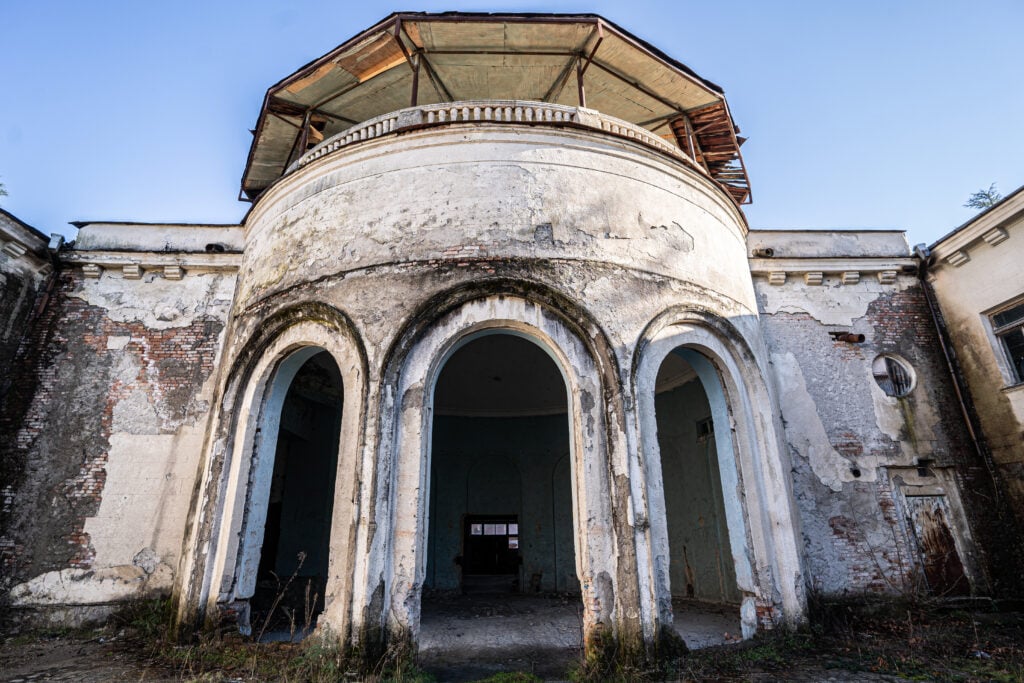
Tskaltubo, in western Georgia (a twenty-minute drive from Kutaisi), was once the most famed spa town in the former Soviet Union. A carefully engineered utopia of mineral-rich springs and brutalist architecture, built to rejuvenate the working masses, its grand hotels and treatment complexes attracted tens of thousands each year from across the USSR. But since the collapse of the Soviet Union and the violent war in the breakaway territory of Abkhazia in the early 1990s, Tskaltubo has taken on a second life — as a place of refuge.
For over 30 years, the town’s derelict spas and hotels have sheltered families displaced by war. These are people who fled their homes under gunfire, buried their loved ones in gardens, and crossed mountains on foot. Many of them have spent most of their lives here, in buildings never meant for permanent habitation.
I travelled to Tskaltubo to explore the once grand spa town’s story, discovering its origins as a Soviet health resort, its transformation during the Abkhazian conflict, and the lives of the people who still call its ruins home.
Keep reading, or watch my YouTube video below to find out more:
Table of Contents
The origins of Tskaltubo
The healing reputation of Tskaltubo dates back to the 7th century, when people first noticed steam rising from the earth. But it was in the 1920s, under Soviet rule, that the town’s therapeutic waters were officially recognised. The springs were rich in radon and sulphur, believed to treat everything from arthritis to cardiovascular ailments.
Under Stalin — himself a Georgian — Tskaltubo became a flagship resort. The dictator is even said to have regularly visited, staying in the now refurbished Tskaltubo Legends Spa Resort, which back then was reserved for high-ranking Soviet officials and military officers. Direct train lines from Moscow brought thousands to the town. By the 1950s, it boasted over 22 sanatoriums and bathhouses, many designed in a classical Stalinist style of the day, each offering accommodation, canteens and on-site doctors for those Soviet citizens visiting on state-sponsored holidays.
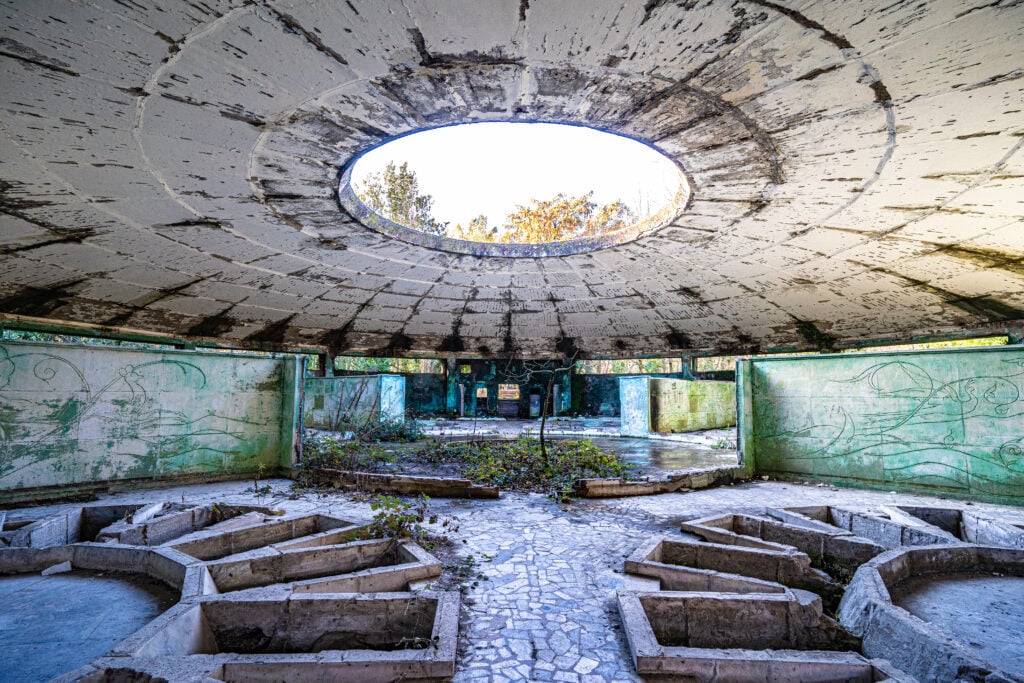
“1953 was when the city was officially declared,” Lasha said, as we explored the derelict hulk of Sanatorium Aia, where Soviet mosaics still gleam under layers of dust and grim. “By the 60s and 70s, it was one of the most famous resorts in the Soviet Union.”
The infrastructure was vast: performance halls, treatment centres, public parks, and an impressive central balneological area where guests could be doused in warm mineral water or subjected to electrotherapy treatments. It was wellness by decree, and for decades it thrived.
But with the decline of the Soviet Union came decay. By the late 1980s, maintenance faltered. Then the empire collapsed — and with it, the system that had supported Tskaltubo.
Read more: Is Georgia a Country? Everything You Need to Know.
War and displacement: The Abkhazian Conflict
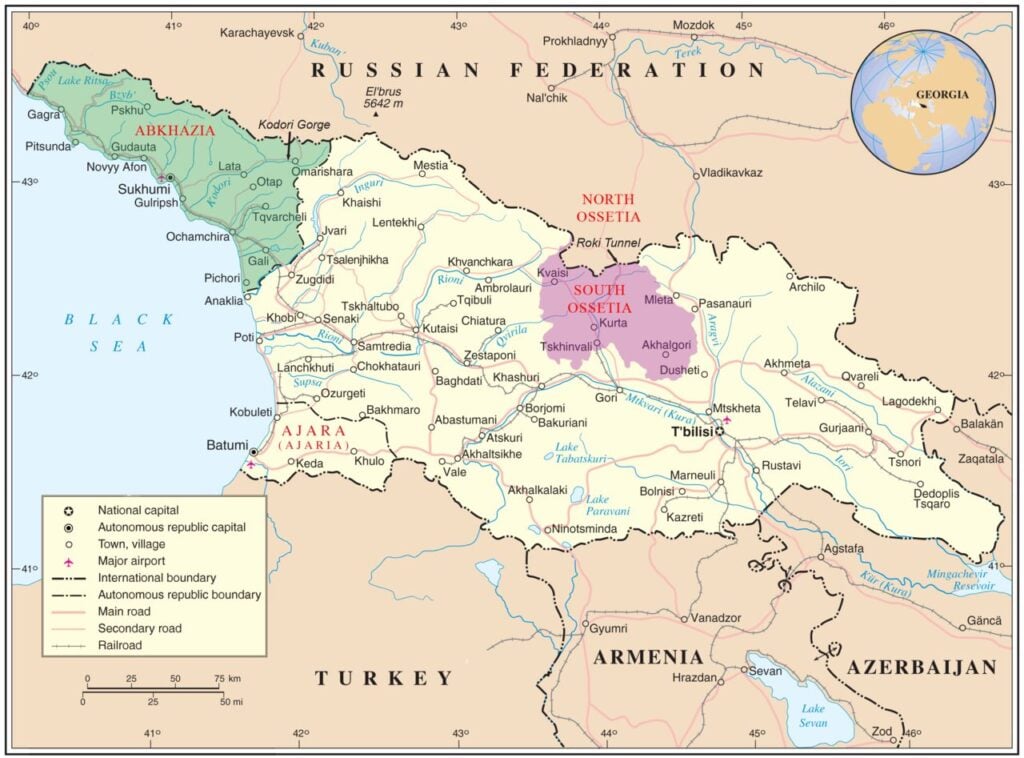
In 1992, a year after Georgia declared independence, conflict erupted in Abkhazia, a Black Sea region in the northwest. Backed by Russian forces and local separatists, Abkhazia declared independence from Georgia. What followed was a brutal 13-month war marked by ethnic cleansing and massive displacement.
Over 200,000 people, mostly ethnic Georgians, were forced to flee their homes. An estimated 25,000 were killed. Entire communities vanished overnight.
“There was nowhere for them to go,” Lasha, whose family became refugees themselves, explained. “The sanatoriums in Tskaltubo — empty after the fall of the Soviet Union — became shelters.”
The transformation was immediate. Marble foyers became communal kitchens. Guest rooms turned into makeshift bedrooms. Ornate staircases creaked under the weight of families forced to share space with strangers.
“Almost 980 families moved into Tskaltubo,” Lasha said. “Buildings were repurposed overnight. It wasn’t planned. It was survival.”
Read more: Is Abkhazia a Country? Everything You Need to Know.
A bond forged in ruin
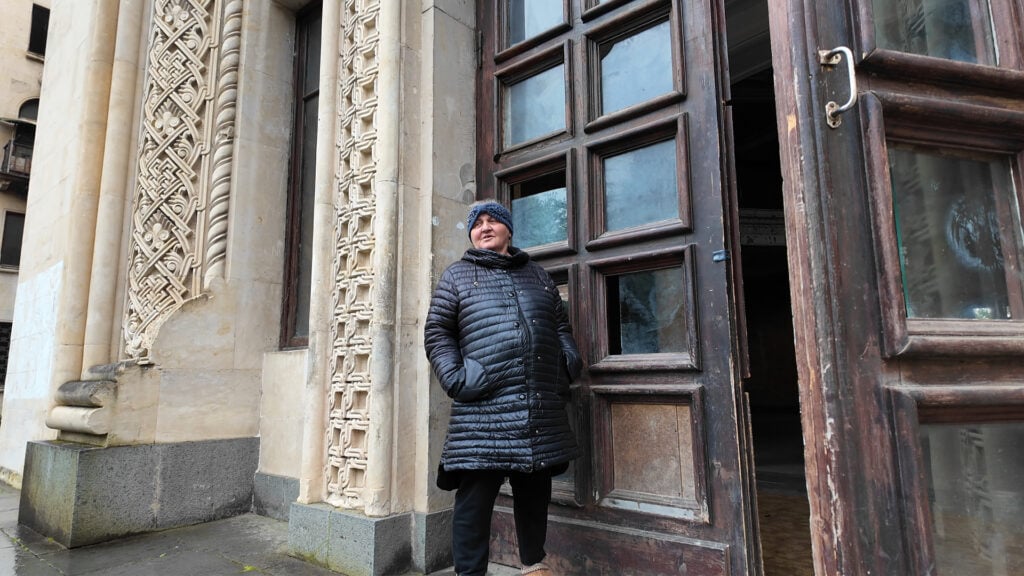
At Sanatorium Metallurgy, one of the largest and best-preserved ruins, we met Dali, a woman who has lived there since the 1990s. She greeted us with coffee and homemade khachapuri. Her kitchen was tidy, adorned with photos and religious icons. But behind the warmth was a story of enormous loss.
“She was a mother of three,” Lasha translated. “Her husband was injured in the war. He later died of his wounds here in Tskaltubo. She lost family members. Everything they owned in Abkhazia was destroyed.”
Living with her is Irakli, a man in his forties who she raised like a son. His story is one of the most devastating we heard.
“He lost nine members of his family in one day,” said Lasha. “He was 11. He dug their graves himself in their garden.”
Irakli suffers from chronic illnesses, including anxiety, skin conditions, and neurological damage from trauma. His hair turned white at 13. He has never been granted state housing due to a bureaucratic point system.
“Hope is the last thing to die,” he told us. “But it must rest on something solid. For us, even hope has become difficult.”
The forgotten generation
Just down the road, in a new apartment block on Abkhazia Street (named for a lost homeland) built by the Georgian government for refugees, we met Gvanca, a painter and artist who fled Abkhazia in 1993. She was 13 when she arrived in Tskaltubo.
“For years, we felt like strangers,” she said of her time growing up in the sanatoriums. “We lived in buildings not meant for people. We worked jobs we never trained for. Our generation was forgotten.”
Her flat is small but filled with colour. She’s self-taught, having learned art through books and experimentation. She returned to Abkhazia only once — to bury her father. Her mother still lives there under a temporary Russian-issued document. “I don’t think I’ll ever be able to go back to live there. But I keep it alive through my work.”
She sees her art not as healing, but as remembrance. “The past isn’t over. It just waits.”
At the derelict Friendship Sanatorium (the first Sanatorium ever built in Tskaltubo), we met Zura, an elderly man who fled Abkhazia in 1993. He welcomed us with toasts and recited poetry from memory.
“Georgian is the richest language,” he said, pouring homemade wine. “It is the soul of our people.”
Zura lives among dusty books in a crumbling room filled with verses by Rustaveli, the famed Georgian poet. He toasted to peace, to visitors, and to the dead, pouring glasses from an oversized plastic bottle filled with homemade Georgian wine.
“We must honour those who come with peace,” he said. “Gaumarjoz— to victory.”
Today, Abkhazia remains a breakaway state recognised by only a handful of countries. Russian troops control its borders. For Georgians, it is an occupied territory — a part of their country they can’t return to.
Most IDPs cannot visit without a Russian or Abkhaz permit. Those who do often return shaken by what they see: overgrown homes, destroyed cemeteries, looted buildings. A place trapped in time, perhaps more so than even than Tskaltubo.
“Abkhazia was paradise,” said Irakli. “Now, it is memory.”
For many, the hope of return is fading. Younger generations have never seen their ancestral villages. But the trauma remains, passed down through stories, photographs, and the ruins of Tskaltubo.
Read more: Exploring Georgia: Batumi On The Black Sea
Hope, memory, and the future of Tskaltubo
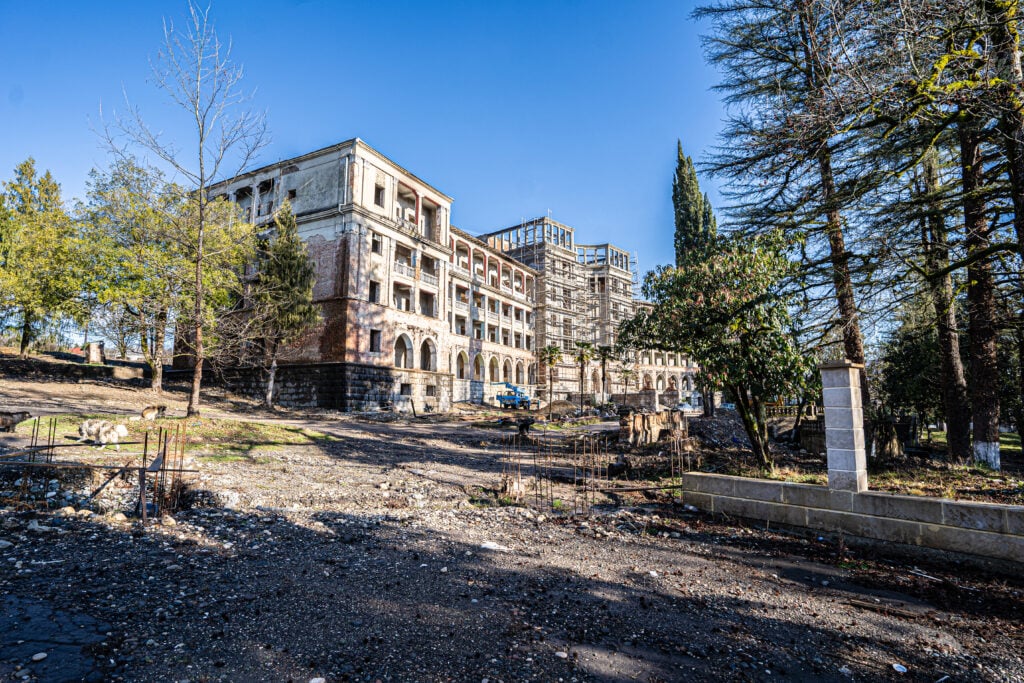
In recent years, Georgia’s tourism boom has brought attention back to Tskaltubo. Developers have begun converting old sanatoriums into luxury hotels. Tour companies now run urban exploration tours through the ruins.
Some buildings have been fully renovated, like the Tskaltubo Legend Spa Resort, offering modern spa treatments in restored Stalinist settings. Others remain occupied by families or left to decay.
“There’s money coming in,” Lasha admitted. “But people need to remember — these aren’t just buildings. They’re stories. They’re homes.”
The contrast is jarring. Tourists sip cocktails in restored ballrooms while down the road, Dali boils water on a camping stove.
Since 2010, the Georgian government has rehomed many IDPs in new apartment blocks. But challenges remain: limited jobs, inadequate mental health care, and a lingering sense of abandonment.
“Some people will never leave the sanatoriums,” Lasha said. “They’ve lived here for thirty years. They’ve raised children here.”
Abkhazia Street — where many new flats stand — symbolises this strange limbo. It is named for the territory its residents fled. Every brick, every doorway, is a reminder of what was lost.
But despite it all, people survive. They raise children, write poetry, make art, and share coffee. And they remember.
“Hope is the last thing to die,” Lasha had again, as we left Sanatorium Metallurgy earlier that day. In Georgia, despite the travails and troubles of ongoing conflict and displacement, hope never seems to die.

Read more: Top Things To Do In Georgia!
How to visit Tskaltubo
Tskaltubo was once an Urbex dream, given the large number of abandoned Soviet buildings. However, the stories of the people living inside these crumbling Sanatoriums were often lost, too. The town is compact. You can walk between most sanatoriums and bathhouses, or use short taxis for outliers. If you plan to photograph derelict buildings, be mindful that some still house internally displaced people (IDPs); always ask before entering, and respect no‑entry signs.
I’d recommend joining a tour with the local company Budget Georgia. Your guide will likely be Lasha, who knows many of the residents in the old hotels and can translate their stories for you. Residents like Dalia and Irakli are happy to share their stories with tourists (they want the outside world to know what happened in Abkhazia), but also remember that many more people still live in these buildings (and not everyone wants tourists tramping through their corridors).
Kutaisi International Airport (KUT) is the closest gateway. Tskaltubo is about 25–30 minutes by taxi from the terminal. Tbilisi (TBS) and Batumi (BUS) are alternatives, but both add several hours overland.
From Kutaisi city, frequent Marshrutka services run from Kutaisi’s central bus station to Tskaltubo (20–30 minutes). However, Bolt and local taxis are inexpensive and the quickest option.
From Tbilisi, take the Georgian Railways train to Kutaisi (Rioni or Kutaisi International Airport). From there, hop in a taxi or marshrutka to Tskaltubo. There are also regular bus and Marshrutka departures from Didube station to Kutaisi; change for Tskaltubo. From Batumi, again take the train to Kutaisi International Airport or a bus to Kutaisi City.
There are now several hotels in Tskaltubo. I’d personally recommend staying at Tskaltubo Legends Spa Resort, where you can ask about the infamous ‘Stalin Room’. Tskaltubo is still a ‘Spa’ town. Many of the old springs have been refurbished, including Spring No.6. However, don’t expect hot tubs and saunas. The ‘Spas’ still offer Soviet-style health treatments, which include consultations with doctors followed by prescribed treatments for your ailments!
There you are. Tskaltubo. A place where the legacy of the Soviet Union is keenly felt. Will you be travelling to Tskaltubo?