From forgotten Buddhist temples to bullet-marked colonial forts, discover the best things to do in Jaffna, Sri Lanka.
For decades, Jaffna was cut off from the outside world. During Sri Lanka’s protracted civil war, the peninsula was considered a no-go zone, its roads guarded by checkpoints, its landmarks overshadowed by the conflict between the government and the Liberation Tigers of Tamil Eelam (LTTE).
Since the war’s brutal end in 2009, however, Jaffna has reopened to the outside world. This former war zone is now a destination where travellers can engage with a Tamil heritage, enjoy the north’s distinctive cuisine, and explore layers of history shaped by Portuguese, Dutch, and British colonial rule.
The city’s temples, colonial fortifications, lively markets, and outlying islands reveal a culture that has preserved its identity despite years of upheaval. For visitors willing to travel to Sri Lanka’s far north, Jaffna offers insights into the country that cannot be found amongst the busy beach resorts in the south.
Keep reading, or watch my YouTube video, to discover the best things to do in Jaffna.
Table of Contents
The best things to do in Jaffna
For centuries, Jaffna has stood apart from the rest of Sri Lanka, both geographically and culturally. At the northern tip of the island, separated from India only by the shallow waters of the Palk Strait, the region developed close ties with South India. It was the heartland of the medieval Jaffna Kingdom, a Tamil polity that thrived from the 13th to the 17th century until it was conquered by the Portuguese and later absorbed into Dutch and then British colonial territories. These shifting rulers left their marks in fortifications, churches, and administrative buildings, while Tamil communities continued to sustain their language, religion, and traditions.
In the decades following independence in 1948, Jaffna was known as a centre of learning, with its schools and libraries producing many of the island’s leading intellectuals. Yet rising ethnic tensions between the Sinhalese-majority state and Tamil communities across the north and east pushed Jaffna into the forefront of Sri Lanka’s civil war. For nearly three decades, from the early 1980s, the peninsula was synonymous with conflict. Checkpoints, displacement, and fierce battles turned it into a no-go zone for outsiders.
Since the war’s end in 2009, Jaffna has gradually reopened. I visited in May 2025 and found a peninsula layered with history, where the trauma of conflict is still raw, but where the signs of rebuilding and reconciliation are everywhere. Here are the best things to do in Jaffna City and the wider Jaffna Peninsula.
1. Stand on the colonial ramparts of Jaffna Fort
The best place to start your Jaffna journey is at the city’s central fort, which is one of the peninsula’s most prominent landmarks. Jaffna Fort stands as one of the most tangible reminders of the peninsula’s layered past.
First built by the Portuguese in 1618, it was expanded by the Dutch and later held by the British, serving as both a military outpost and an administrative centre. Its star-shaped bastions and surviving gates reflect European colonial architecture adapted to South Asia, and the walls offer sweeping views of the Jaffna Lagoon.
During Sri Lanka’s civil war, the fort became a contested stronghold, badly damaged in fighting. Today, although partially restored, you’ll still find bullet marks and shrapnel damage in the colonial brickwork.

2. Uncover Jaffna Public Library’s harrowing story
Jaffna Public Library is one of the most significant landmarks in northern Sri Lanka. Opened in 1933, it quickly became one of Asia’s finest libraries, housing over 90,000 volumes, including rare Tamil-language manuscripts and centuries-old works.
A cultural hub for the Tamil community, this revered place of learning unfortunately came to symbolise the worst of the ethnic divides rocking Sri Lanka apart. In 1981, the library was deliberately set ablaze during ethnic unrest. A Sinhalese mob assaulted the library, throwing petrol bombs and destroying its priceless collection.
For decades, it was a symbol of cultural loss for the Tamil people. After the Civil War, however, the building was reconstructed. While the irreplaceable texts are gone, the library has resumed its role as a public institution and a source of regional pride.
Visitors are allowed inside the library, but remember to respect the many students you’ll find working and reading within!

3. Admire Jaffna Clock Tower
Jaffna Clock Tower stands in the heart of the city. This colonial-era landmark not only tells the times, but it’s layered with history. Built in 1875 to commemorate the visit of Albert Edward, Prince of Wales (later Edward VII), it reflects the architectural style of British civic monuments of the period.
Rising above the main streets, the tower became a familiar point of orientation for generations of residents. It suffered damage during the civil war but was restored in 2002 with British assistance, reaffirming its symbolic link to a shared, if contested, colonial past.
Read more: 10 Best Things to Do in Trincomalee, Sri Lanka
4. Visit Nallur Kandaswamy Kovil
Nallur Kandaswamy Kovil is the most prominent Hindu temple in northern Sri Lanka. The spiritual heart of Jaffna (Tamils typically practice Hinduism), the temple is dedicated to Lord Murugan and has stood in various forms since the 10th century. The present structure you’ll find today dates largely from the 18th century, after earlier versions were destroyed during Portuguese rule.
Its towering golden gopuram dominates the skyline, while the inner sanctum and pillared halls reflect the Dravidian style of temple building closely linked to South India. The kovil is especially renowned for its annual festival in August, which lasts for 25 days and draws devotees from across Sri Lanka and the Tamil diaspora.
Ceremonies include processions with chariots, drumming, and kavadi dancing, creating one of the island’s most intense displays of devotion. Visitors are allowed to enter, so long as you respect the pilgrims and ceremonies (men are in fact expected to go shirtless!).

5. Delve into Sri Lankan history at Jaffna Archaeological Museum
If you’re intrigued by the region’s long history, then a trip to the Jaffna Archaeological Museum is a must. This compact but fascinating museum was established to preserve ancient artefacts uncovered across the Jaffna Peninsula and nearby islands.
The museum’s collection spans Buddhist, Hindu, and colonial periods, reflecting Jaffna’s role as a crossroads of cultures. Among the displays are stone sculptures of Hindu deities, fragments of Buddhist stupas, and relics from the medieval Jaffna Kingdom.
Portuguese and Dutch influences appear in coins, ceramics, and weapons, while everyday objects such as tools and jewellery illustrate the continuity of local life across centuries. For visitors, the museum complements sites like Nallur Kandaswamy Kovil and Jaffna Fort, which I found don’t offer too much in the way of historical context
Read more: How Many Countries in South Asia? Everything You Need to Know.
6. Explore Jaffna’s Buddhist side at Kadurugoda Viharaya
Jaffna has long been a multicultural hub, and while Tamils are ordinarily Hindu, there’s a big Buddhist influence (Sri Lanka as a whole is a majority Buddhist nation, of course). During my trip to Jaffna, I visited Kadurugoda Viharaya and found it to be one of the peninsula’s most intriguing archaeological sites.
A complex of around 60 small stupas constructed largely from coral stone, the site is believed to date back to the Anuradhapura period, more than a thousand years ago. Providing rare evidence of the presence of Buddhism in the predominantly Hindu north, local traditions suggest the stupas were built to enshrine the remains of monks who died during an epidemic.
Excavations have also uncovered coins and artefacts linking the site to trade networks that connected Jaffna with the wider Indian Ocean. Though modest in scale compared to the monumental stupas of the south, Kadurugoda is historically significant, offering insight into the peninsula’s diverse religious past and the ways Buddhism once coexisted alongside Hindu traditions.

7. Lose your way in Jaffna Market
Jaffna Market is the commercial heart of the peninsula and an excellent place to experience daily life in the north. Located in the city centre, it brings together traders selling everything from fresh produce and seafood to textiles, spices, and everyday household goods.
The market is particularly known for regional staples: red chillies, dried fish, jaggery made from palmyra palm, and traditional sweets unique to Jaffna’s Tamil culture. During the years of conflict, the market was often subdued, but today it has regained its role as a lively hub where rural and urban communities meet.
On the main street by the entrance to the market, I’d also recommend visiting the Malayan Cafe. One of Jaffna’s oldest restaurants, you can enjoy traditional Tamil cuisine served on banana leaves.

8. Take a dip at Kīrimalai Sacred Water Springs
Kirimalai Sacred Water Springs are located on the northern coast of the Jaffna Peninsula. They’re among the most revered natural sites in the region. The freshwater springs rise at the base of a cliff just metres from the sea, creating large bathing pools that have been used for centuries for both ritual and healing.
Local belief holds that the waters possess curative powers, particularly for skin ailments, and pilgrims come year-round to bathe. The springs are closely associated with the nearby Naguleswaram Kovil, one of the five ancient Shiva temples of Sri Lanka, reinforcing the site’s spiritual significance.
According to legend, a sage cursed with a lion’s face was restored to human form after bathing here, linking the springs to myth as well as medicine. Visitors are allowed to take a dip, or you can just stroll along the beachfront and admire the spectacular coastline.

9. Spend the night at Fort Hammenhiel
Fort Hammenhiel is a small but striking coastal fortification located on an islet between the Kayts and Karaitivu islands in the Jaffna Lagoon. Built by the Portuguese in the early 17th century and later strengthened by the Dutch, it was designed to guard the narrow channel leading into the Jaffna Lagoon.
Constructed of coral and limestone, the fort is circular in shape, unlike the star-shaped bastions of larger European forts on the island. The Dutch and British both used it as a prison, a role it continued to play even into the 20th century. During Sri Lanka’s civil war, its strategic location gave it renewed importance, though rather curiously, today it has been converted into a guesthouse operated by the Sri Lankan Navy.
Surrounded by calm waters and accessible only by boat, Fort Hammenhiel offers visitors both a glimpse into the colonial military architecture of the north and an unusual overnight experience steeped in colonial history.

10. See wild horses on Delft Island
Visiting Delft Island is one of the most distinctive experiences in the Jaffna Peninsula. Reached by a short but often crowded ferry ride from the mainland, the island feels worlds apart from the city. Its landscape is marked by open scrubland, coral walls, and herds of wild ponies introduced by European colonisers, which still roam freely.
Remnants of colonial rule remain visible in the ruins of a Dutch fort, an ancient Portuguese church, and a massive baobab tree believed to have been planted by Arab traders centuries ago. The island’s coastlines are rugged and windswept, offering solitude rather than conventional beaches.
Daily life here is slow-paced, shaped by fishing and small-scale farming, giving visitors a sense of the peninsula’s remoteness. Without many modern facilities, Delft is best explored as a day trip, combining history, folklore, and a stark natural environment unlike anywhere else in Sri Lanka.
Read more: The Gruesome Story of Sigiriya, Sri Lanka’s #1 Tourist Attraction
11. Pay your respects at Elephant Pass
Elephant Pass is the narrow isthmus that links the Jaffna Peninsula to the rest of Sri Lanka. Long regarded as the “gateway” to the north, its name recalls the elephants that once crossed the lagoons here. Its modern history, however, is inseparable from war.
During Sri Lanka’s civil war, the pass became infamous. It was the site of repeated battles between government forces and the LTTE. Control of Elephant Pass meant control of access to Jaffna, and it changed hands several times with heavy casualties.
Today, travellers crossing the causeway see stark salt pans and birdlife on either side, but also the prominent Elephant Pass War Memorial, erected by the Sri Lankan Army to honour soldiers who fought and died there.

12. Visit Point Pedro, Sri Lanka’s most northerly point
For geography fanatics like myself, there’s no better place to visit when you’re in Jaffna than Point Pedro. Known locally as Paruthithurai (“cotton harbour”), Point Pedro marks the northernmost tip of Sri Lanka.
This significant geographical location has long been a place where geography and history converge. Once a modest port town, it traded cotton and other goods across the Palk Strait with South India, reflecting the peninsula’s maritime ties. Under Dutch and British rule, the harbour was developed further, though today only traces of its commercial past remain.
The headland itself is windswept and exposed, with a lighthouse, colonial ruins, and military remnants recalling both its strategic importance and its role in the civil war.
Read more: How Many Countries in Asia? Everything You Need to Know.
13. Try some Palmyra Toddy (if you dare)
Tapped from the palmyra palm, which dominates the peninsula’s landscape, toddy is a mildly alcoholic drink produced from the sap of the tree’s flower. At dawn, skilled tappers climb the tall, spindly palms to collect the sap in pots, a tradition that has continued for generations.
Fresh toddy is supposedly sweet and slightly effervescent, but when fermented, it develops a stronger, more sour flavour. I thought it tasted like old socks, but the locals seemed to love it.
It was unclear if producing Toddy was legal when I was in Jaffna (we stopped at a very low-key, almost underground distillery), but the locals can point you in the right direction should you be willing to try it.

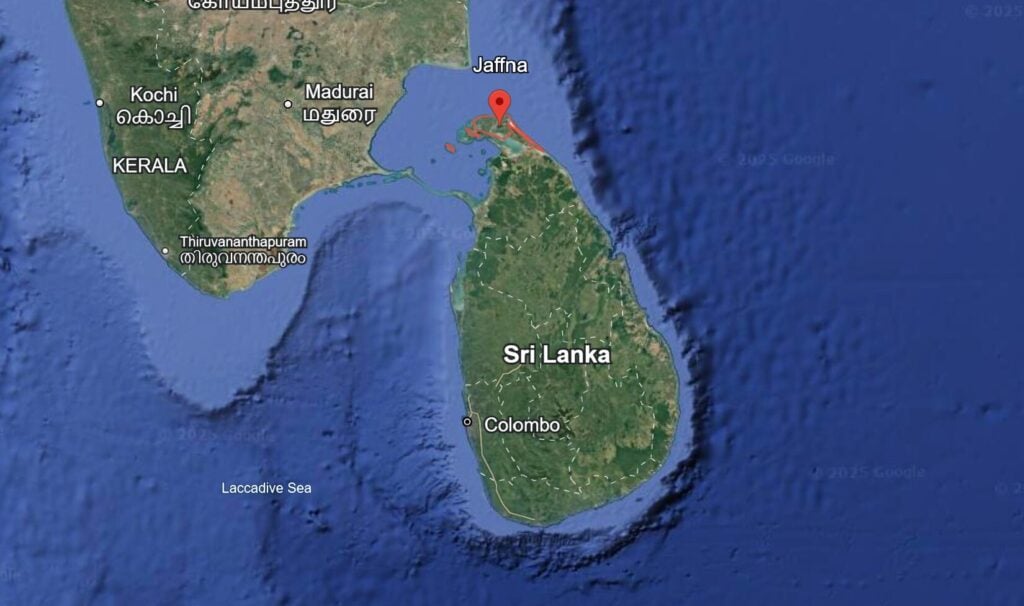
Map of the best things to do in Jaffna
Here’s a map of the best things to do in Jaffna:
How to visit Jaffna
Reaching Jaffna is all part of the experience itself. From Colombo, the best option is the Yal Devi Express, the train that once symbolised the north–south connection before being halted during the civil war. Today it runs again, covering the 400 kilometres in around 7 hours. Buses and private vehicles take a similar route along the A9 highway, crossing Elephant Pass — once the frontline in the Civil War. For those short on time, domestic flights from Colombo to Jaffna International Airport take just over an hour.
Within Jaffna city, tuk-tuks are the easiest way to move between landmarks, while scooters or bicycles are easy to rent from guesthouses. To explore the wider peninsula — from Point Pedro to Keerimalai, or the islands of Delft and Nainativu — hiring a driver or renting a scooter is a must. Small ferries connect the offshore islands, weather permitting.
Thanks to the Sri Lankan Tourism Board and the British Guild of Travel Writers for hosting this press trip to Sri Lanka.
Thanks to Danushka from Blue Lanka Tours for guiding us around Trincomalee: https://www.bluelankatours.com/
There you have it! The best things to do in Jaffna. Will you be visiting the north on your next trip to Sri Lanka? Let us know in the comments below!