Discover the brutal and bloody story of Sigiriya, Sri Lanka’s iconic and top-rated tourist attraction.
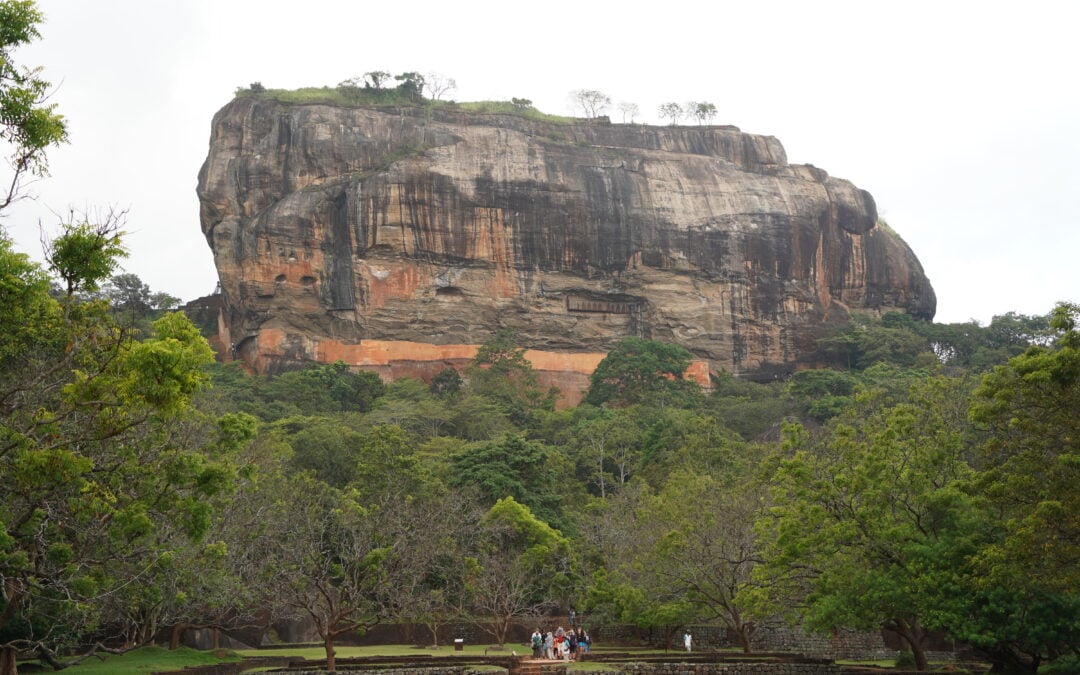
High above the forests of central Sri Lanka, a great block of volcanic stone rises from the plains, its summit scarred with the remains of ancient walls, gardens, and pools. This is Sigiriya, better known as Lion Rock, where geology and political ambition collided in the late fifth century AD to produce one of the most remarkable sites in South Asia.
Now one of Sri Lanka’s top tourist attractions, Sigiriya hides a curious, yet gruesome history. Its builder, King Kashyapa, came to power through bloodshed. In 477 AD, he murdered his father and usurped the throne from his half-brother Moggallana. Fearing retribution, he sought a location he could defend from all sides. Sigiriya, with its sheer cliffs and panoramic views, was the answer.
Kashyapa transformed the rock into a fortress-palace: moats and landscaped gardens at its base, an upper palace crowning the summit, frescoes of hundreds of women painted across its caves, and a massive lion-shaped entrance guarding the way.
Kashyapa’s reign ended as violently as it began, and Sigiriya was abandoned. Today, the site stands as an archaeological wonder and a cautionary tale about power, fear, and the impermanence of glory.
I climbed its 1,202 steps to explore its dark and turbulent history and ask what Sigiriya still has to say about modern Sri Lanka.
Keep reading, or watch the full video below:
Table of Contents
What and where is Sigiriya?
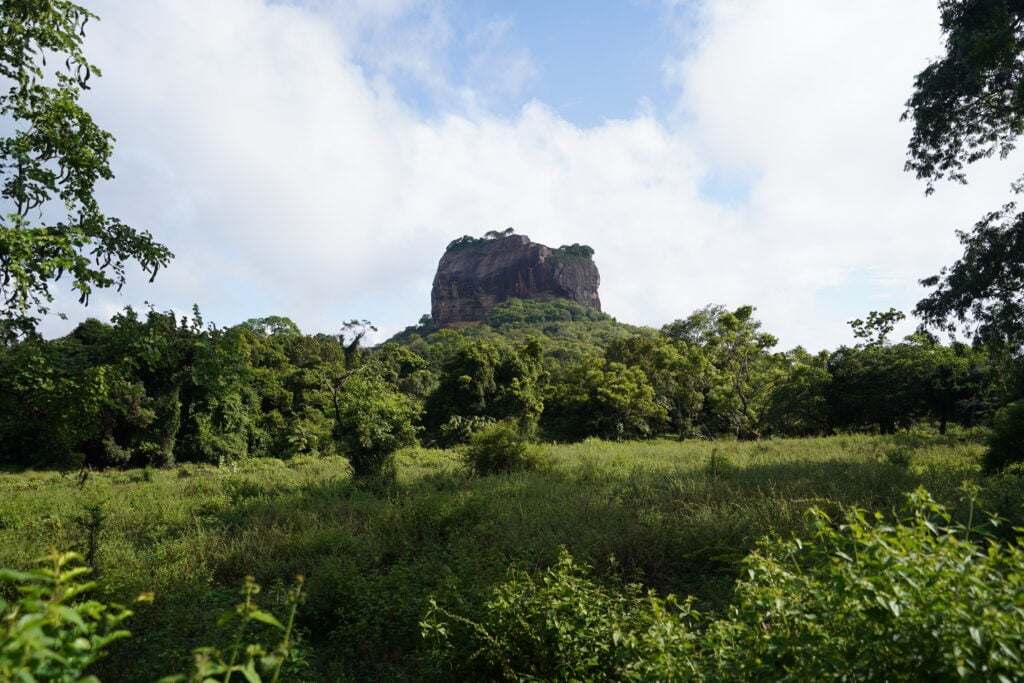
Sigiriya is an ancient rock fortress located in Sri Lanka’s Central Province, roughly midway between the historic cities of Anuradhapura and Kandy. The site centres on a vast column of volcanic rock, rising about 200 metres above the surrounding plains and 368 metres above sea level. Its name comes from Sinhagiri — “Lion Rock” in Sinhala — a reference to the colossal lion-shaped gateway that once guarded the main entrance.
In the late fifth century AD, King Kashyapa transformed Sigiriya into his capital, constructing an upper palace on the summit, a lower palace at the base, elaborate water gardens, and defensive moats. The rock’s flanks were adorned with frescoes depicting hundreds of women, while a polished ‘mirror wall’ reflected the king’s image. After Kashyapa’s death in 495 AD, Sigiriya became a Buddhist monastery before falling into decline. Today, it is a UNESCO World Heritage Site and one of Sri Lanka’s most iconic landmarks.
At the base of the rock itself, local guide Mr Nishantha told the Lion Rock’s story in blunt terms. “The citadel on top of Sigiriya was built by a king who killed his own dad to seize power,” he said of Kashyapa’s patricidal actions so many centuries ago.
He explained how the assassination took place in Anuradhapura, the island’s royal capital at the time. Kashyapa was not the legitimate heir. That role belonged to his half-brother Moggallana. After murdering King Dhatusena in 477 AD, Kashyapa feared immediate retaliation. Moggallana fled to India to raise an army, leaving Kashyapa with a reprieve. But he knew vengeance was coming.
Kashayapa moved the capital from Anuradhapura to Sigiriya, selecting a vast rock “two and a half million years old. A volcanic rock 200 metres from ground level, 368 metres above sea level,” as Nishantha explained. The location offered strategic views and sheer cliff faces that made assault difficult.
Read more: How Many Countries in South Asia? Everything You Need to Know.
A fortress fit for a megalomaniac
Between 477 and 495 AD, Sigiriya was transformed. Kashyapa oversaw the construction of both winter and summer palaces, ringing the site with double moats, landscaped gardens, and three grand entrances.
The three gateways were symbols of authority: a lion, elephant and cobra. The lion entrance, most famous today, once featured a colossal sculpted head. Visitors would walk through the lion’s mouth, then climb the rock-hewn steps to reach the palace atop the rocks. Now, only the lion’s feet remain, and tourists instead tackle a windswept metal walkway to the summit.
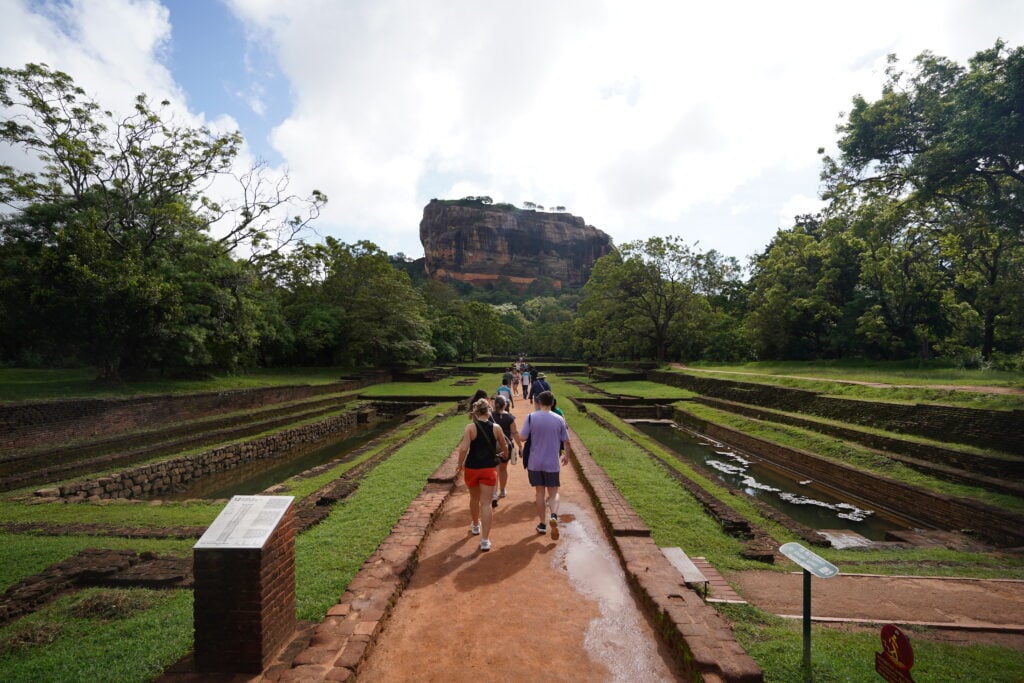
Sigiriya’s gardens are among the oldest landscaped urban spaces in South Asia. They speak to an aesthetic sensibility as much as to military engineering. If the fortifications spoke of fear, the art and amenities reflected indulgence. “He never married,” said Nishantha. “But he had 500 dancing girls,” he added as we walked past the women’s pools built for their use. Frescoes of these women adorned caves and sheltered rock faces, too.
One particularly notorious feature was the mirror wall. Once coated with lime and polished with egg whites, it produced a reflective surface, so Kashayapa could admire his own likeness when he walked past. Sigiriya, in this reading, is as much about personal vanity as it is about defence.
For 18 years, Kashyapa ruled from Sigiriya. Then, in 495 AD, Moggallana returned from exile with his army. What followed was the decisive mistake of Kashyapa’s life. Instead of remaining behind his formidable defences, he marched out to meet his brother near present-day Habarana, where many of the region’s resorts and hotels are today located.
Accounts differ on the battle’s specifics, but all agree that Kashyapa’s forces faltered. “He lost the battle. Then he decided to commit suicide,” Nishantha explained. By some traditions, he cut his own throat on the battlefield rather than be captured.
Moggallana claimed the throne but did not reside at Sigiriya. Instead, he returned it to the Buddhist monastic order. The monks, though, did not like the frescoes of Kashayapa’s dancing women, according to Nishantha, and so the site fell into abandonment.
Read more: How Many Countries in Asia? Everything You Need to Know.
The climb to Sigiriya’s summit
Today, Sigiriya is recognised as a UNESCO World Heritage Site and one of Sri Lanka’s top tourist attractions. Getting to the top of the Lion Rock, however, requires a physical ascent of 1,200 steps, followed by what Nishantha called “two bonus steps at the very top.” The climb passes first through landscaped grounds, then up steep staircases, and narrow pathways cut into the rock.
There are hazards beyond the incline. “They have a real problem with hornets and wasps here,” Nishantha warned, pointing out emergency shelters. He advised visitors to stay quiet, as noise can provoke swarms, particularly on hot days when large groups of tourists summit the rock.
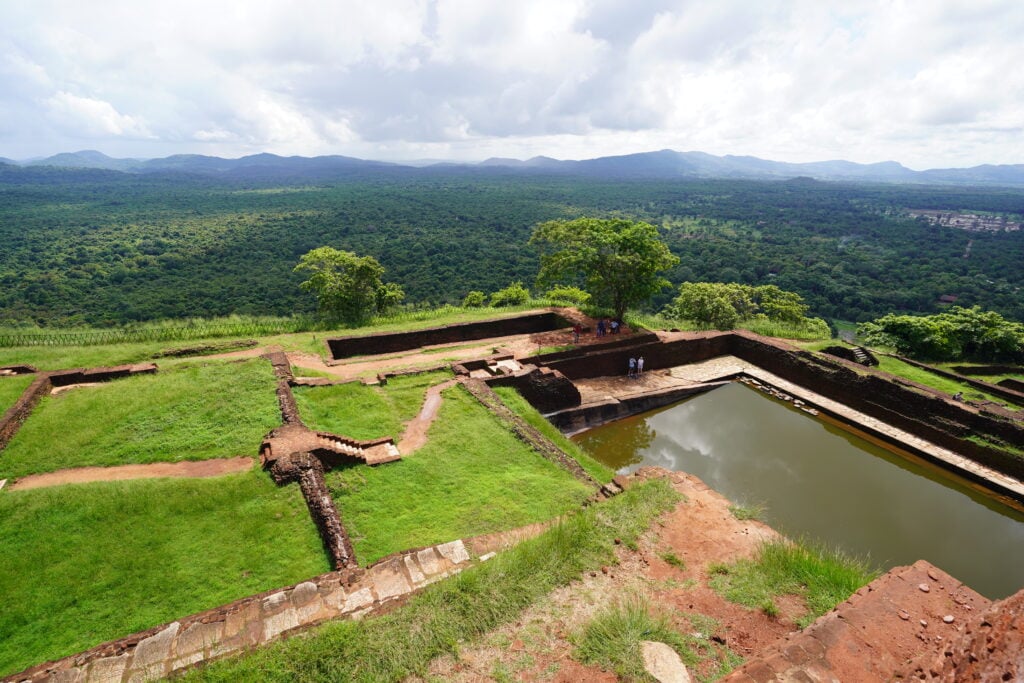
The weather is another factor. When it rains and thunderstorms, the top can get hit by lightning, and the metal steps become incredibly slippery. As we climbed, the wind was picking up, and rain clouds gathered above. At the summit, the layout of the winter palace is still visible. The large swimming pool, once filled with rainwater, remains intact.
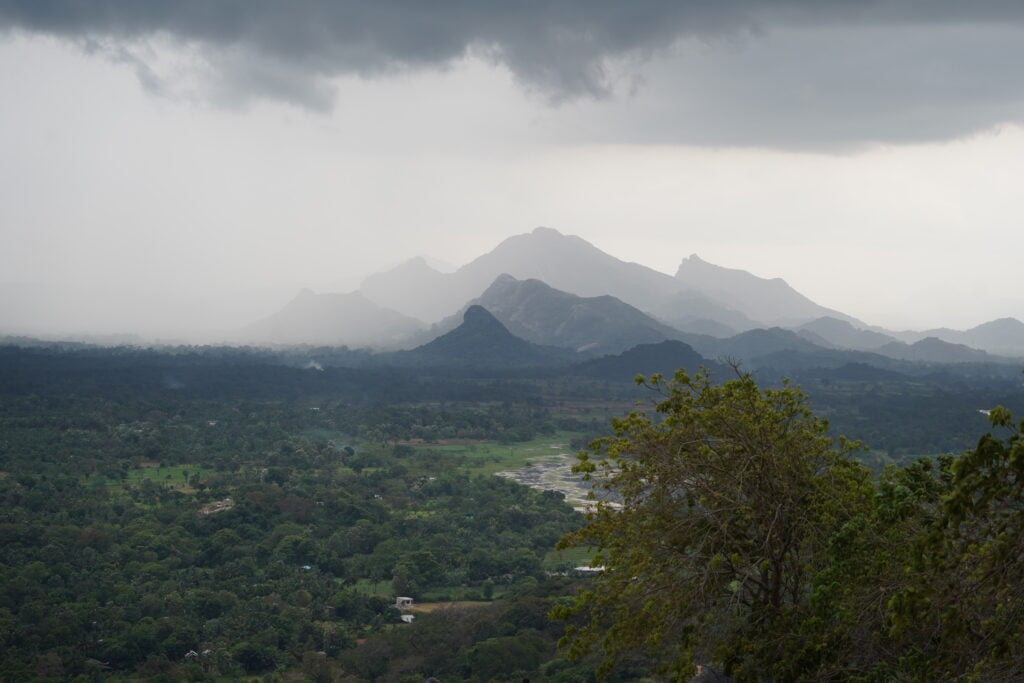
From here, the views stretch towards the mountains that hide Kandy, the island’s last independent capital before the British conquest in 1815. The descent, however, began under a downpour. We sought shelter in the fresco cave, where the surviving paintings of Kashyapa’s ‘dancing girls’ can still be seen. Photography is prohibited, but their stylised features remain vivid despite the centuries.
Sigiriya in the Sri Lankan historical arc
It’s tempting to view Sigirya as a monument to one man’s maniacal existence, a patricidal maniac who became king after murdering his own father. But it also fits into a broader pattern in Sri Lankan history: the shifting of capitals for strategic, environmental, or political reasons.
From Anuradhapura to Polonnaruwa, from Dambadeniya to Kandy, the island’s rulers have moved their seats of power in response to invasion threats, dynastic disputes, or colonial pressure. Sigiriya is unique in that it was purpose-built as a fortress-palace, and that it was abandoned almost as soon as it was finished.
It’s been a tourist attraction longer than it was ever a seat of power, but its fascinating, if bloody, story still grips travellers centuries after its demise. In the modern era, that’s why Sigiriya has become a symbol not of Kashyapa’s reign but of Sri Lanka’s ancient heritage.
How to visit Sigiriya
Here’s a quick guide to visiting Sigiriya, the Lion Rock, when you’re in Sri Lanka:
Getting to Sigirya
Sigiriya is located in Sri Lanka’s Central Province, about 15 km from the town of Dambulla, where I stayed at the magnificent JetWing Lake hotel. Colombo, the Sri Lankan capital, is around 170 km to the southwest. Travellers can reach Sigiriya by car, hired driver, or public bus via Dambulla, followed by a short tuk-tuk ride to the site. From Kandy, the drive takes roughly two and a half hours.
Opening hours & tickets
The site is generally open from early morning (around 7:00 AM) until late afternoon (usually 5:30 PM, with last entry mid-afternoon). Foreign visitors pay a higher entrance fee than Sri Lankan nationals, with tickets including access to the gardens, frescoes, and summit.
I’d recommend either going as early as possible to avoid both the heat and the crowds or late in the afternoon. The midday sun can be intense, and climbing in high humidity is taxing. Mornings also offer better lighting for photography, while the sunset is marvellous (just get down from the summit before darkness!).
Prepare for a steep ascent: 1,202 steps wind through landscaped gardens, boulder paths, and narrow metal staircases clinging to the rock. Wear sturdy shoes, carry water, and be ready for strong winds at the top. There are hornet shelters along the route — keep quiet if they’re active.
- Non-SAARC foreign adult: US $35
- SAARC foreign adult (e.g., citizens of India, Bangladesh, etc.): US $18–20
- Local adult (Sri Lankan): LKR 120 (~US $0.40)

Thanks to the Sri Lankan Tourism Board and the British Guild of Travel Writers for hosting this press trip to Sri Lanka.
Thanks to Danushka from Blue Lanka Tours for guiding us around Sri Lanka: https://www.bluelankatours.com/
And thanks to JetWing Lake, in Dambulla, for hosting me before and after my hike to Sigiriya!
Have you visited Sigiriya? Let me know in the comments below!