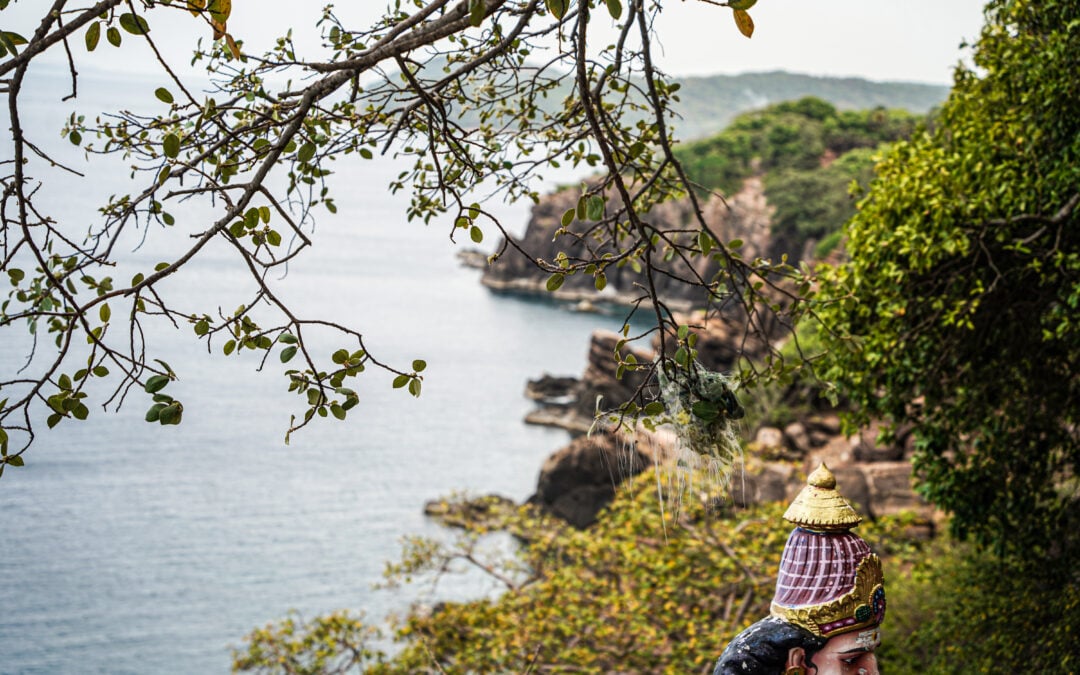
From beautiful beaches to sacred Hindu temples perched atop cliffs, discover the best things to do in Trincomalee, Sri Lanka’s up-and-coming port city.
Just 20 years ago, Trincomalee was effectively a no-go zone. As the Sri Lankan Civil War raged around this ancient port city on the island’s northeastern shores, Trincomalee became a militarised zone, a place where Tamil and Sinhalese communities clashed with often bloody outcomes.
But things have changed. Restricted areas have opened, beach resorts line a stunning coastline, and tourism is on the rise ever since the brutal civil war came to a close in 2009. I visited Trincomalee in May 2025, as part of a wider journey exploring the once-conflict-ravaged north of Sri Lanka. I found a city in the midst of transformation. A place that could indeed, perhaps, be considered a ‘New Bali’, if you enjoy those sorts of labels, that is.
Amongst beach shacks, ranks of tuk tuk drivers, backpacker hostels and luxury hotels, however, the historic heart of Trincomalee has never disappeared. Its vast natural harbour—one of the finest deep-water anchorages in the Indian Ocean—has drawn merchants, colonisers and navies from South Asia, Europe and beyond for centuries. Tamil, Sinhalese, Arab and European influences have each left marks in its architecture, rituals and traditions, as Hindu, Buddhist and Muslim sites stand within sight of each other.
If you’re planning a trip to northern Sri Lanka, then keep reading, for my take on the best things to do in Trincomalee, or watch my YouTube video below:
Table of Contents
The best things to do in Trincomalee
Here are the best things to do in Trincomalee:
1. Take a pilgrimage to Koneswaram Temple (Thirukoneswaram Kovil)
First up is the Koneswaram Temple, one of Sri Lanka’s most revered Hindu sanctuaries and a landmark of the island’s Tamil heritage. Dedicated to Lord Shiva, it stands atop Swami Rock, a dramatic promontory overlooking the Indian Ocean and the vast natural harbour below. References to the temple appear in early Tamil literature, suggesting origins stretching back more than two millennia.
For centuries, it attracted pilgrims from across South Asia, but in 1624, Portuguese colonisers demolished much of the complex, casting its statues and shrines into the sea. Several were rediscovered centuries later and reinstated. The temple was rebuilt in the mid-20th century and today combines ancient relics with modern Dravidian architecture. Beyond its religious significance, Koneswaram reflects Trincomalee’s layered past; a site of devotion, destruction, recovery and continuity, still central to Tamil cultural identity.

2. Uncover colonial history at Fort Frederick
Fort Frederick dominates the headland above Trincomalee, its weathered gates and thick ramparts a reminder of centuries of colonial rivalry. Built by the Portuguese in 1624 over the ruins of the ancient Koneswaram Temple, the fort was later expanded by the Dutch and then passed into British hands in 1795.
Its position gave European powers control of one of the world’s finest natural harbours, making Trincomalee a strategic prize in Indian Ocean trade and warfare. The British developed the site as a naval stronghold, and during the Second World War it became a key Allied base, bombed by Japanese aircraft in 1942.
Today Fort Frederick is still partly occupied by the Sri Lankan military, but visitors are free to wander its grounds. Inside, Trincomalee’s famed deer roam freely among colonial-era barracks, while the restored Koneswaram Temple sits within its walls, offering a striking contrast between military history and enduring spirituality.

3. See Trincomalee Harbour, one of the world’s largest natural harbours
Trincomalee Harbour is the city’s defining feature. A vast, sheltered inlet recognised as one of the largest natural harbours in the world, it’s enclosed by headlands and deep enough to anchor entire fleets. The harbour has drawn merchants, colonisers and navies to Trincomalee for more than two millennia. Ancient Tamil texts mention Gokanna, as it was once called, as a hub of maritime trade along the Bay of Bengal.
The Portuguese seized the harbour in 1624, fortifying Swami Rock after destroying the Koneswaram Temple. The Dutch expanded its defences in the 17th century, while the French briefly took control in 1672. It was the British, however, who made Trincomalee a cornerstone of empire after 1795, constructing 106 oil storage tanks (many of which are still there) and establishing a naval base.
During the Second World War, the harbour became Britain’s ‘Pearl Harbor’, attacked by Japanese aircraft in April 1942. Today it remains a functioning naval port, but also a place where fishing boats, ferries and tankers share waters once contested by empires.
You can see the harbour from many locations in Trincomalee. I’d recommend heading down to the Ocean Breeze Walkway and Viewpoint (see map at the end of this article) for views of the industrial harbour, including the historic oil tankers.

4. Visit the Maritime and Naval Museum
Trincomalee’s Maritime and Naval History Museum offers an excellent introduction to the city’s long relationship with the sea. Housed in a restored 17th-century Dutch colonial mansion near the harbour, the museum was opened in 2013 with support from the Sri Lankan Navy.
Its exhibits trace both natural and human history: displays of local marine biodiversity sit alongside models of historic ships, maps of ancient trade routes, and accounts of colonial rivalries that made Trincomalee so strategically important. Particular attention is given to the harbour’s role during the Second World War, when it became a key British naval base and target of Japanese air raids.
Artefacts recovered from the seabed, including weapons and pottery, highlight how conflict and commerce intersected here for centuries. Informative and accessible, the museum offers context for sites like Fort Frederick and Koneswaram Temple, making it a valuable stop for anyone wanting to understand Trincomalee’s layered past.
Read more: The Gruesome Story of Sigiriya, Sri Lanka’s #1 Tourist Attraction
5. Enjoy sublime views at Hoods Tower Museum
The Hoods Tower Museum, located on a ridge overlooking Trincomalee Harbour, is one of Sri Lanka’s most unusual military museums. Named after the British-built observation post that still crowns the site, it occupies part of a naval complex that once guarded the entrance to the harbour. From here, visitors get a commanding view across the bay, the same vantage point used by sentries to track enemy ships.
The museum itself houses an eclectic collection: naval guns, radar equipment, and communications gear used during the Second World War sit alongside torpedoes, mines, and models of vessels that once patrolled the Indian Ocean. Exhibits also cover the harbour’s long naval history, from colonial struggles between Portuguese, Dutch, French and British powers to its role as a key Allied base during Japanese air raids in 1942.
Though less polished than conventional museums, its raw displays and dramatic setting make it a compelling stop for those interested in Trincomalee’s strategic past.

6. Snorkel around Pigeon Island
Just off the coast from Nilaveli Beach, Pigeon Island National Park offers some of the best marine experiences on Sri Lanka’s east coast. A short boat ride from Trincomalee, the island takes its name from the rock pigeons that still roost in its cliffs.
It is one of only two marine national parks in the country and is prized for its coral reefs, shallow lagoons and abundant sea life. Snorkellers and divers can expect encounters with reef sharks, turtles and shoals of brilliantly coloured fish, while the corals — though damaged by past bleaching and the 2004 tsunami — are slowly regenerating.
The island itself is small and rugged, with rocky outcrops and sandy stretches where day-trippers pause between swims. Strict conservation rules apply, and visitors are urged to use designated paths and avoid damaging coral.

7. Join a whale watching trip
Trincomalee is one of the best places in Sri Lanka to see whales and dolphins, thanks to its deep natural harbour and proximity to nutrient-rich waters of the Bay of Bengal. The season typically runs from March to May and again from August to October, when blue whales migrate along the coast.
Sightings of sperm whales, the largest toothed predators on earth, are also possible, while pods of spinner dolphins are common year-round. Boat trips depart early in the morning from Uppuveli and Nilaveli beaches, heading out into deeper water within a short distance of shore.
While sightings can never be guaranteed, the chances here are among the highest in the region. Responsible operators follow guidelines to avoid disturbing the animals, keeping a respectful distance and limiting time spent with each pod or whale.
Read more: How Many Countries in Asia? Everything You Need to Know.
8. Lounge on Trincomalee’s best beaches
Trincomalee’s coastline is lined with long, pale-gold beaches that feel strikingly different from the crowded resorts of Sri Lanka’s south-west.
Nilaveli Beach, 16 kilometres north of town, is the most celebrated: a broad sweep of sand backed by palms, with calm waters ideal for swimming. It is also the departure point for boats to Pigeon Island, making it a natural base for snorkellers and divers.
Closer to town lies Uppuveli Beach, popular with travellers who want a relaxed setting without leaving the city behind. Guesthouses, cafés and dive shops line the shore, giving it a sociable, low-key character.
For something quieter still, Marble Beach, inside a Sri Lankan Air Force-managed area, was suggested to me by a local Tuk-tuk driver. He said it offers sheltered turquoise waters and a more secluded feel to the rest of Trincomalee’s beaches.

9. Pay your respects at the Commonwealth War Graves Cemetery
Tucked away just north of the city, Trincomalee Commonwealth War Graves Cemetery is a solemn reminder of the area’s strategic importance during the Second World War. Established for British and Allied servicemen who died in and around Trincomalee, it contains 365 graves from across the Commonwealth, including soldiers, sailors and airmen from the UK, Sri Lanka (then Ceylon), India, Australia, New Zealand, Canada, the Netherlands and even East Africa.
Many of those buried here lost their lives in April 1942, when Japanese aircraft attacked the harbour in an operation designed to mirror Pearl Harbor. Others succumbed later to wounds or disease while serving in the Indian Ocean theatre of war.
The site is immaculately maintained by the Commonwealth War Graves Commission, its rows of headstones shaded by frangipani trees. Quiet and contemplative, the cemetery offers a powerful glimpse into the global reach of the war and Trincomalee’s central role within it.

10. Day trip to Kanniya Hot Springs
The Kanniya Hot Springs, a short drive from Trincomalee town, are among the region’s most intriguing historic sites. Consisting of seven square wells built close together, each pool is only a few feet deep but naturally filled with warm spring water. Interestingly, the temperature varies slightly from well to well, inviting visitors to move between them and test the differences.
Local tradition links the springs to both Hindu and Buddhist heritage. According to legend, they were created by Ravana, the mythical king of Lanka from the Ramayana. Nearby ruins suggest that a Buddhist monastery once stood here, and inscriptions indicate the springs were used for ritual bathing as far back as the 1st century CE. Today the site is popular with pilgrims and locals alike, who still come to bathe in the mineral-rich waters.

Read more: How Many Countries in South Asia? Everything You Need to Know.
Map of the best things to do in Trincomalee
Here’s a map of the best things to do in Trincomalee, Sri Lanka:
How to visit Trincomalee
Trincomalee is on the north-eastern coast of Sri Lanka, about 265 km from Colombo, 178 km from Kandy and 233 km from Jaffna. It lies within Eastern Province, facing the Bay of Bengal, and occupies a headland that shelters one of the largest natural harbours in the world. The city sits roughly midway between the Jaffna Peninsula in the north and Batticaloa to the south, making it a strategic link between Sri Lanka’s northern and eastern seaboards.
Here’s how to visit Trincomalee when you’re exploring northern Sri Lanka.
- Private vehicle or taxi – The most direct drive from Colombo follows the A6 highway via Dambulla and Habarana, taking around 5½–6½ hours in light traffic. This route passes close to the Cultural Triangle, making it easy to combine with stops at Sigiriya or Polonnaruwa. From Jaffna, the most direct drive takes about 5½–6 hours via the A9 south to Vavuniya, then east through Horowupotana towards Trincomalee. Roads are generally good, though rural stretches can be slower.
- Bus – Long-distance buses (both government and private) operate from Colombo’s Central Bus Stand to Trincomalee, typically overnight or in the early morning. Expect 7–8 hours, depending on road conditions. Direct long-distance buses (SLTB and private) also link Jaffna and Trincomalee. Expect 7–8 hours, with services usually departing morning or late evening.
- Train – Sri Lanka Railways runs services from Colombo Fort to Trincomalee once or twice daily. The daytime train takes about 8–9 hours, travelling via Kurunegala and Gal Oya Junction. While slower than road travel, it offers a more relaxed journey and the chance to see rural landscapes. There are no direct rail connections to either Jaffna or Kandy, unfortunately.
- Air – Cinnamon Air operates domestic flights from Colombo’s Bandaranaike International Airport (CMB) or Waters Edge in Battaramulla to China Bay Airport, just south of Trincomalee. The flight takes less than an hour, followed by a short road transfer.

Thanks to the Sri Lankan Tourism Board and the British Guild of Travel Writers for hosting this press trip to Sri Lanka.
Thanks to Danushka from Blue Lanka Tours for guiding us around Trincomalee: https://www.bluelankatours.com/
Check out the Amaranthe Bay Resort & Spa, who hosted my stay in Trincomalee.
Have you visited Trincomalee? Let me know in the comments.