
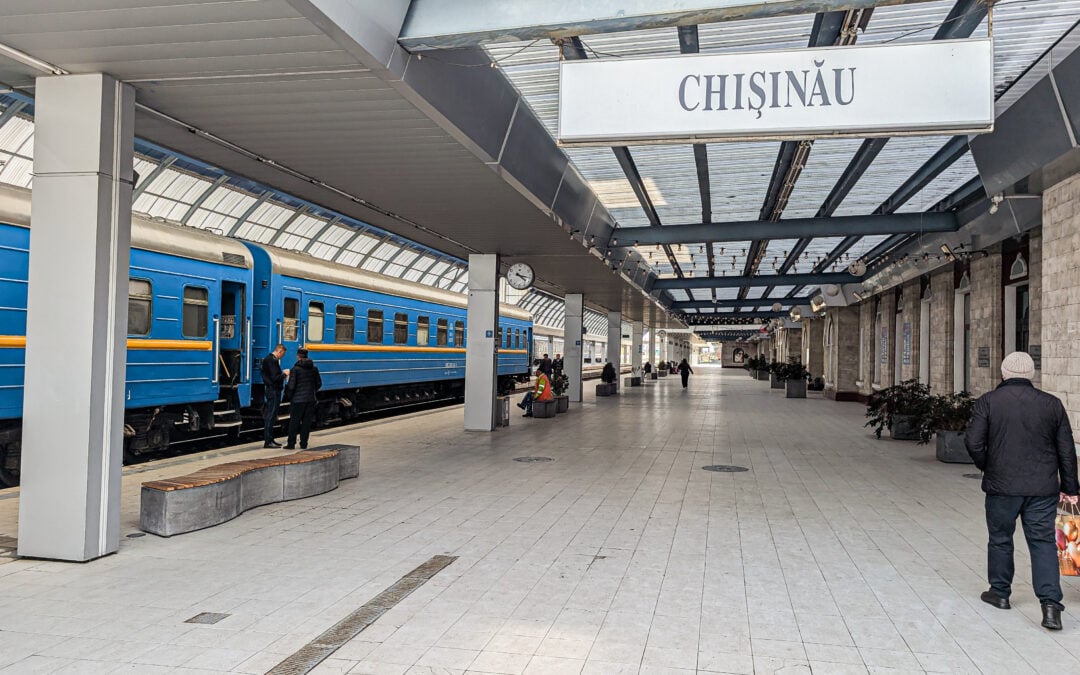
When I rode the Chisinau to Bucharest sleeper train in March 2026, the journey took around 14 hours, covering 600 kilometres as I travelled on one of the last Soviet-style trains still crossing the European Union’s frontier. The wagons were seriously retro, border procedures were mind-numbingly slow, but best of all, I experienced the rare ‘Bogie Exchange’ on the Moldovan-Romanian border as the train switches rail gauges.
The Prietenia, or ‘Friendship Express,’ is a serious blast of Soviet nostalgia. I love it so much, I’ve made the painstakingly ponderous journey twice now. I first took the train from Bucharest to Chisinau in 2015, and you can find the original trip report for that journey at the end of this guide. I returned in 2026 and have updated this guide based on my most recent journey from Chisinau to Bucharest (and spoiler alert: literally nothing changed in a decade!).
Keep reading, and discover everything you need to know about taking the Chisinau to Bucharest sleeper train (and vice versa), including my trip reports, timetables, how to book and where to stay before and after your journey.
Table of Contents
Quick Facts: The Soviet Sleeper train from Chisinau to Bucharest
The Prietenia, or ‘Friendship Express,’ is an antiquated Soviet-era sleeper service connecting Chisinau in Moldova to Bucharest in Romania. And it’s one of my favourite train journeys in Europe!
Here’s a quick guide to the route:
Service No. 401 Chisinau-Bucharest. Departs Chisinau at 16.50 pm. Arrives in Bucharest Nord at 06.48 am. Nightly service.
Service No. 402 Bucharest-Chisinau. Departs Bucharest Nord at 19.06 pm. Arrives in Chisinau at 08.44 am. Nightly service.
Price: I paid 451.70 Romanian Leu (approx £74) for two people sharing a private twin berth on the journey from Chisinau to Bucharest in 2026 (so 225.85 Romanian Leu, or £37, per person).
Duration: Officially 13 hours 38 minutes. In reality, it can take anywhere between 13 and15 hours, depending on how long the border formalities take.
Distance Covered: Approximately 600 kilometres between Chisinau and Bucharest.
Where to buy tickets: I’d recommend booking via the Romanian Railways website (regardless of which way you’re travelling). Bookings open 60 days in advance. When I was at Chisinau Gare, I simply showed the e-ticket on my phone.
My journey from Chisinau to Bucharest
“Frontieră! Frontieră!” The conductor stormed along Soviet-era wagons, informing passengers that we’d arrived at the Moldovan-Romanian border. “Granitsa! Granitsa!” They shouted ‘border’ again, this time in Russian, as we inched closer to Ungheni, where the River Prut marks the divide between these two nations.
It was 19.30 pm. The sun was setting in a blaze of fire over the border, and the faint smell of diesel mingled with the coal-powered heating systems that still warmed this antiquated Soviet sleeper train. We’d set off that afternoon 16.50 pm from Chisinau Gare, and although we’d reached the border less than 3 hours after departure, we still had a long night ahead of us.
The Prietenia, as it’s known locally, makes this journey every evening, connecting Chisinau to Bucharest (and vice versa) on a slow journey that’s changed little since the days of the USSR. Indeed, I was informed by two German backpackers in the buffet carriage – where you can sip on Moldovan wine and Transnistrian cognac as the countryside slowly trundles past – that the wagons were actually manufactured in the old German Democratic Republic (GDR), and are likely the last of their era still operating within the European Union.
Bogie Exchange at the border
The railway line’s route is itself even older. This dates back to the 1870s, when Moldova was part of the earlier Russian Empire. The Russians built on the wider 1520mm gauge, whereas Romania – like much of the rest of Europe – used the narrower 1435mm gauge. As the story goes, the Russians built their railways on this different gauge for defence, making it far more difficult for trains to carry an invading army over the border and across the vast Russian Empire.
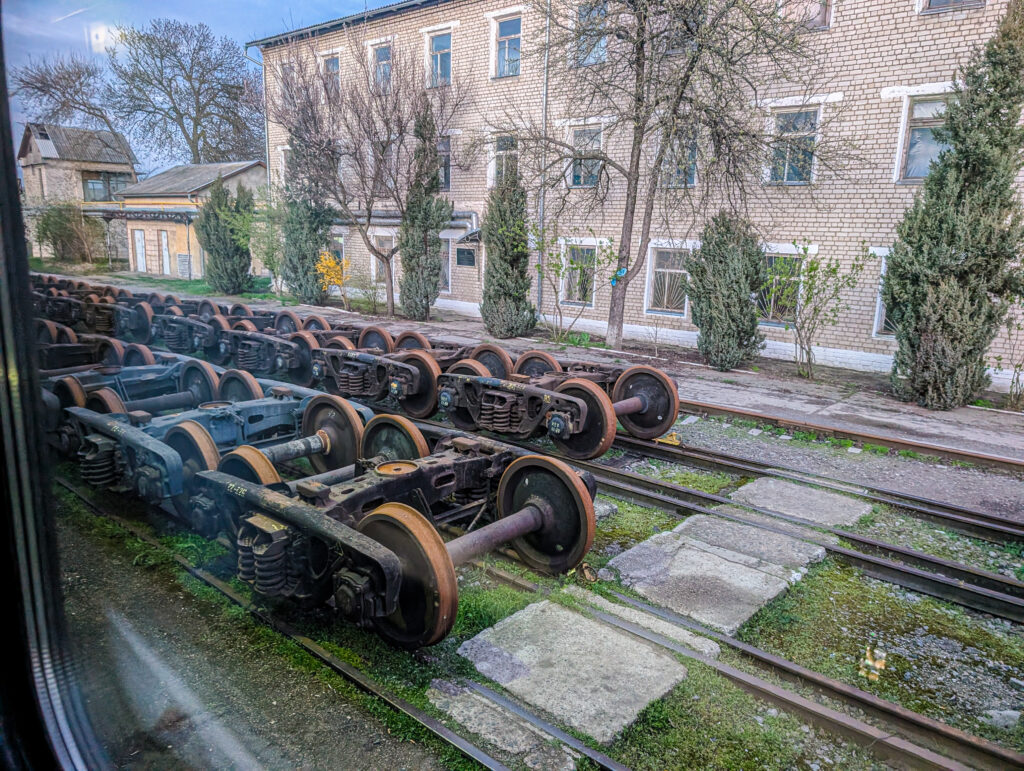
For the modern-day traveller, this meant I was in for a long night at the Moldovan-Romanian border. Before my journey could continue, each wagon was individually jacked up at the border. The Moldovan wheels were removed, and new wheels rolled underneath to fit the Romanian gauge railways. It was a process repeated down the long line of wagons, late into the night. For train lovers, it’s a fascinating experience, as this is one of the rare bogie exchanges left on the EU’s frontier.
While the bogie exchange happened at Ungheni, my passport was whisked away by Moldovan immigration. Customs officers did the rounds next, and I was asked if I had any “guns, drugs or alcohol” by a stern-faced man in an official-looking uniform. The bogie exchange took longer than I anticipated. That was because a Ukrainian Railways train arriving from Kyiv also endured the same gauge-changing process before their wagons (which were much more modern than the Moldovan Railways wagons) were tacked onto the end of our train.
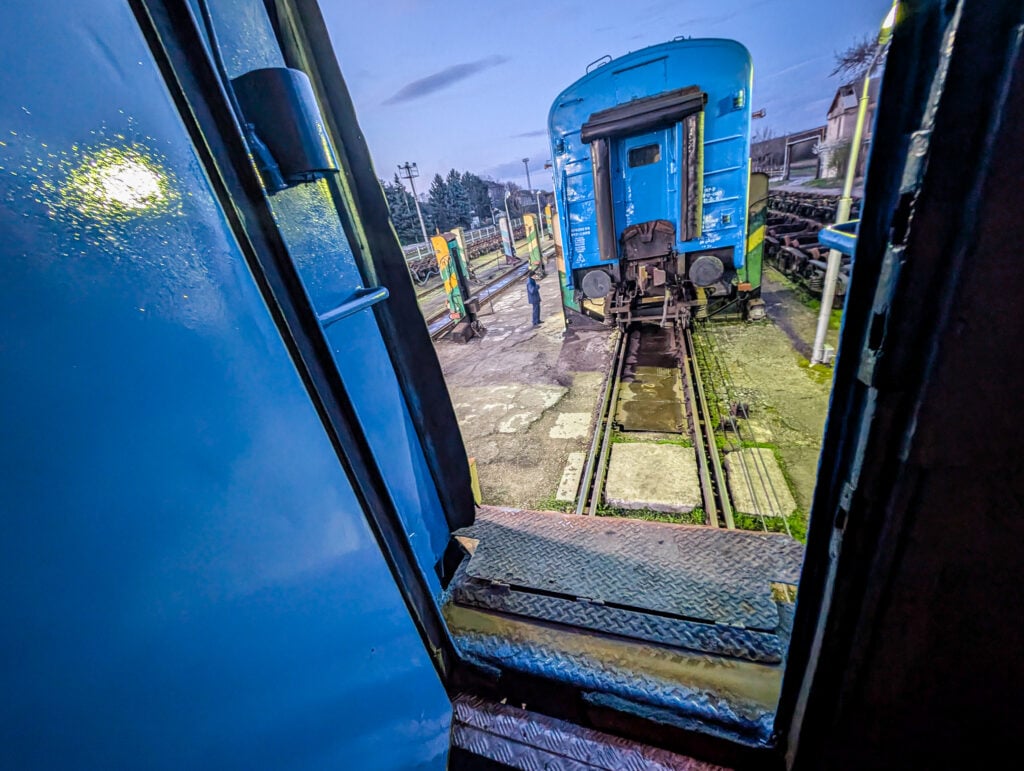
From Ungheni border to Bucharest
2 hours after arriving at the border, the bogie exchange was complete, and we crossed over the Eiffel Bridge spanning the River Prut and into Romania. My latest journey took place in March 2026, when Romania was rolling out the EU’s new Entry/Exit System (EES). Romanian immigration officers entered the train, checked passports and took fingerprints and facial recognition scans in the cabins. Luckily, we’d packed a lovely bottle of Milestii Mici’s finest wine for the journey. There was little to do but sip on Moldovan red wine as border formalities played out through the late evening.
By 21.45 pm, we’d officially crossed the border and entered Romania. After setting up the aged cabin for the night, I conked out on the bed and was awoken around 7 am as we neared Bucharest.
I won’t lie. Given the unorthodox bogie exchange and protracted border procedures, it’s a long and at times tedious journey. But given there are few sleeper trains like this left in Europe, it’s certainly a journey I’ll happily endure again.
TOP TIP: Take supplies!
I’ve heard rumours that some trains have full service dining carriages. This didn’t seem to exist either time I’ve taken the train, but there is a buffet carriage serving limited drinks and a few snacks (they accepted card and cash payments, in Romanian Leu and Moldovan Lei). However, I’d highly recommend stocking up on a few supplies before you depart from Chisinau or Bucharest, because you’re in for a long night at the border!
Watch my full journey on the Chisinau Bucharest sleeper train on YouTube:
Read more: Is Moldova a Country? Everything You Need to Know.
Chisinau to Bucharest Timetable (and vice versa)
There are nightly departures each way.
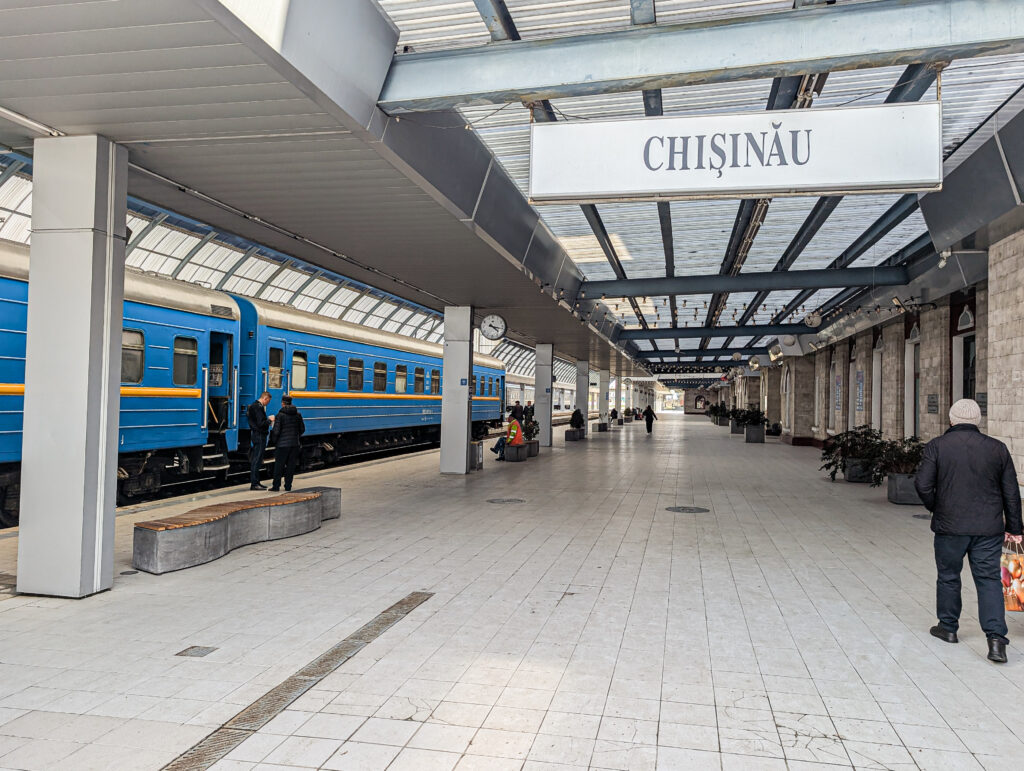
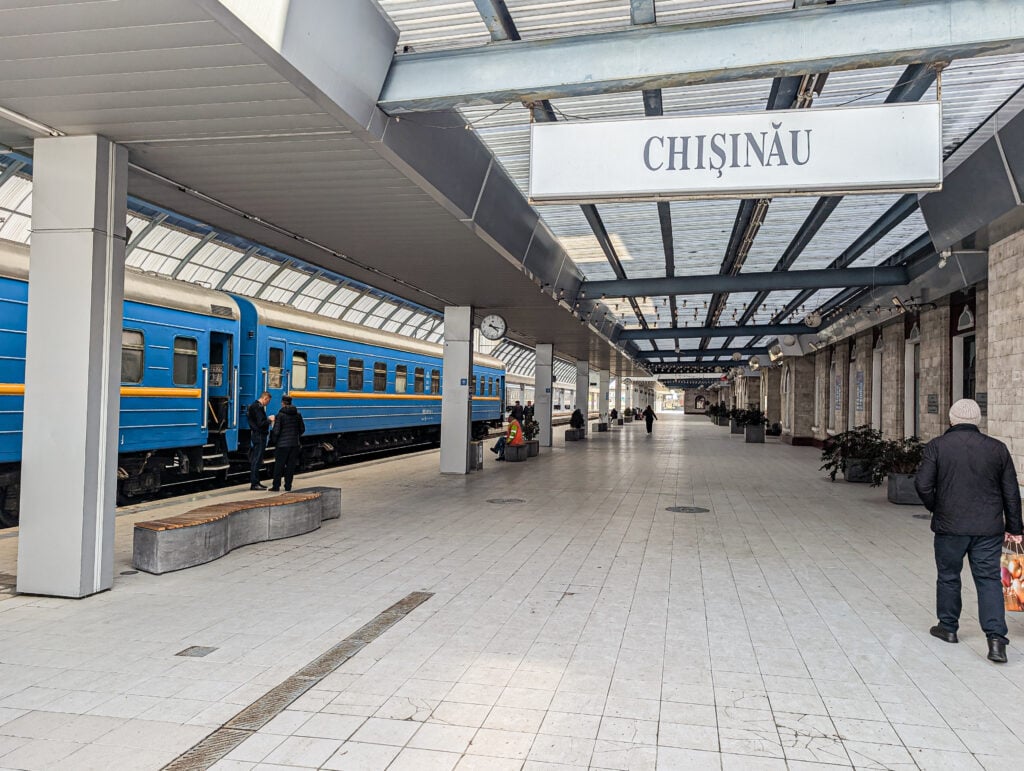
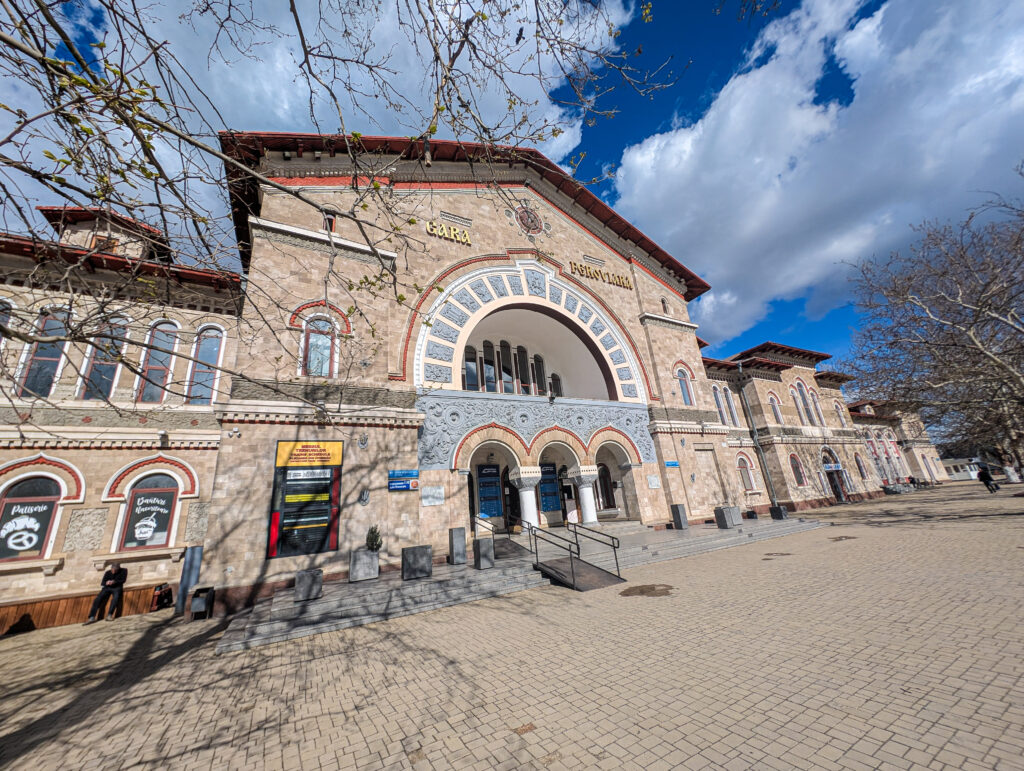
In Chisinau, the train departs from Chisinau Gare. It’s a grand old building, originally constructed during the Russian Empire. It was largely destroyed during the Second World War, and rebuilt in the Soviet era. It’s a small station, and there aren’t many departures other than to Bucharest or Kyiv. There’s a small shop outside the station where you can grab some beer and bread, and there’s quite often a flea market in the nearby streets where you can buy old Soviet souvenirs.
In Bucharest, you’ll need to catch the train from Bucuresti Nord (Bucharest Nord). It’s far larger and far more chaotic than Chisinau Gare, but there are a lot more cafes, supermarkets and fast food chains where you can stock up on supplies for the journey.
According to the official timetables:
401 Chisinau to Bucharest Timetable
Departs Chisinau: 16.50 pm
Arrives at Ungheni, Moldovan border: 19.34 pm
Departs Ungheni Prut, Romanian border: 22.35 pm
Arrives Bucharest Nord: 06.38 am
402 Bucharest to Chisinau Timetable
Departs Bucharest Nord: 19.06 pm
Arrives Ungheni Prut, Romanian border: 04.09 am
Departs Ungheni, Moldovan border: 06.11 am
Arrives Chisinau: 08.44 am
How to buy tickets for the Chisinau-Bucharest train
When I first took the train over a decade ago, you had to buy the tickets from the railway station in either Bucharest or Chisinau. Thankfully, this part of the journey has been updated, and you can now book your tickets online!
I’d suggest booking via the Romanian Railways website as the system worked much better than the Moldovan website. You can switch the Romanian Railways website to English, then just click on ‘International Journeys’ and search for Chisinau to Bucharest (or Bucharest to Chisinau).
You essentially buy a fare for the journey (which costs 168.27 Romanian Leu pp), then pay extra to reserve a berth (which I believe is mandatory for this journey, as there were no seated wagons). There are 3 types of reservation you can make. Either sole occupancy of a twin berth cabin, a bunk in a shared twin berth cabin, or a bunk in a four-person shared couchette.
I booked a two-person cabin for myself and my partner. We paid a total price of 451.70 Romanian Leu (approx £74) for both of us, so 225.85 Romanian Leu, or £37, per person.
I looked up the current prices on the Romanian Railways website, which are accurate as of 17th August 2026. Standard fares (quoted below) are refundable up until the day of travel. There are cheaper, special offer fares available on certain days too, but these are typically non-refundable and don’t seem to save you much.
Current fare prices
Sole occupancy of a twin berth cabin: 328.02 Romanian Leu pp (approx £53)
Shared occupancy of a twin berth cabin: 248.15 Romanian Leu pp (approx £40)
Shared occupancy of a four-berth couchette: 221.52 Romanian Leu pp (approx £36)
As you can see, there’s not much difference in price between sharing a four-berth couchette and having your own private cabin (and if there are two of you travelling, it’s a no-brainer in my opinion to go for the twin berth). Tickets open 60 days in advance, however, so it’s possible the better options may sell out. So I’d recommend booking in advance if you know when you’re travelling.
Read more: Is Transnistria a Country? Everything You Need to Know.
What are the cabins on the Chisinau to Bucharest train like?
It’s review time!
So what are the cabins like on The Prietenia? Well, don’t arrive expecting luxury. That’s really not the point of this train. Instead, be ready for an overdose of Soviet-era comforts, and a largely sleepless night.
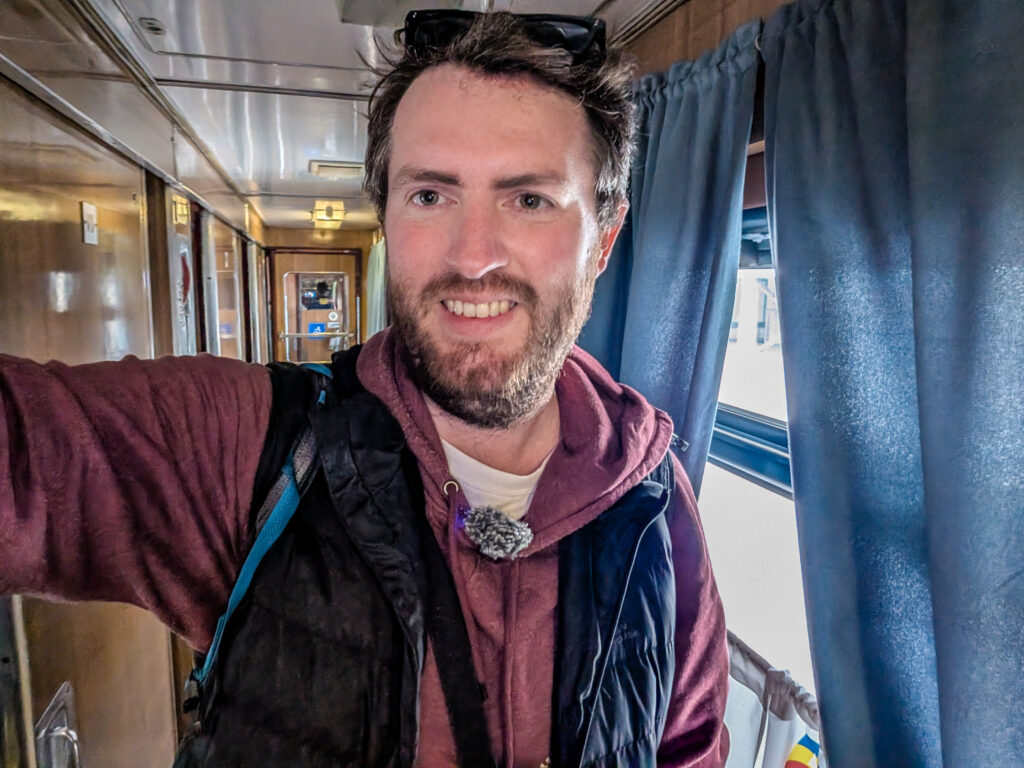
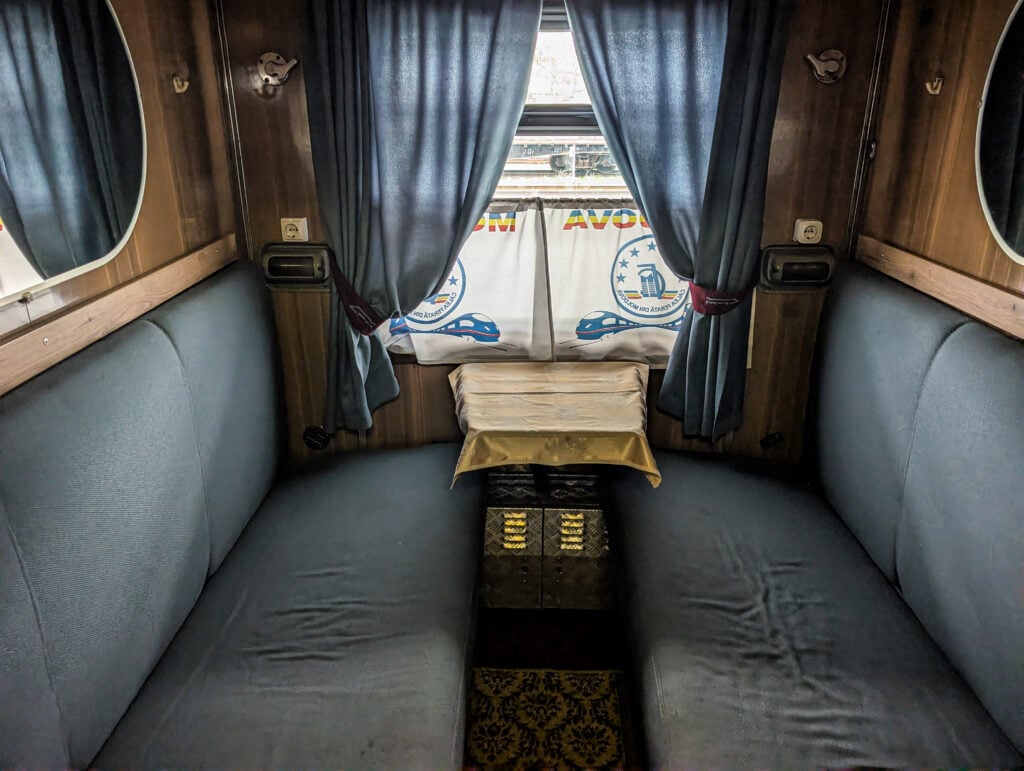
The wagons are decades old, and the only decor that’s likely been updated is the curtains. As you’ll see in the picture I took of the twin cabin I stayed in below, there are now little Moldovan Trains flags in the windows. During the days of the USSR, Moldova didn’t exist as an independent nation, so obviously, these have been updated since.
The couches fold out into sleeping berths, and there’s a little table in between where you can eat your bread and cheese and sip on Moldovan wine. Underneath the beds you’ll find fairly large storage areas for larger bags, which customs inspectors will thoroughly search at the border.
Bedding is provided by the conductor, but you’ll need to make the beds up yourself. As a 6-foot-4 man, I found the beds to be rather short, but that’s the case on almost every sleeper train I’ve ever taken. The onboard shared toilets are sparse but functional. There’s no shower.
The real downside is the heat. The wagons are heated by a coal-powered furnace. There was literally a man at the end of the corridor whose entire job was to constantly stoke the heater. Unfortunately, this meant the train seemed to get hotter and hotter throughout the night, and there was no way to control the heat in the cabin except for opening the window. It’s a very noisy train, and once the window is open, I found it impossible to sleep because of the racket outside (foolishly, I forgot my earplugs!).
It’s certainly an experience, but if you board the train knowing you’re unlikely to sleep much, it’s an exceptional journey.
Where to stay in Chisinau and Bucharest (before or after your journey)
Chisinau Gare is a short Bolt ride away from the city centre. Accommodation options are sparser in Chisinau than in Bucharest, but much improved compared to my first stay in the city back in 2015. Your money will go a lot further in Chisinau than in Bucharest too, and it’s a great opportunity to splash out on a luxury spa hotel before you endure the overnight train to Romania.
I personally stayed at the Roxen Hotel & Spa when I was in Chisinau. The rooms were more than comfortable, the service great, and the breakfast excellent. There’s even a swimming pool. I’d highly recommend spending a few days here before catching the train, as you’re almost equidistant from the city centre and the train station.
In Bucharest, I stayed at the functional but admittedly bland Hello Hotels Bucharest. I’ll be honest, there’s nothing particularly special about this hotel. It does the job, though, and its selling point is really the fact that it’s just a five-minute walk from Bucharest Nord. Oh, and they did provide free luggage storage when we arrived, bleary-eyed, at around 8 in the morning.
Which way should I take the train?
I’ve made the journey twice (read my 2015 trip report directly below), and I’ve experienced the Prietenia in both directions. If you have a choice, then I’d highly recommend taking the Chisinau-Bucharest route.
The primary reason for this is the fact that when travelling from Chisinau to Bucharest, you reach the border at a reasonable time in the evening. Yes, it’s still a long crossing with the wheel changes and all that, but you’ll have a solid 6 or 7 hours (if you’re lucky) to try and sleep once you’ve entered Romania.
On the journey from Bucharest to Chisinau, you reach the border at an ungodly hour in the early hours of the morning. You won’t see much of the Bogie Exchange in the darkness, and quite frankly, you’ll be knackered when you make it to Chisinau.
That’s my humble opinion. Let me know in the comments if you disagree.
Read more: Top Things to Do in Chisinau!
My 2015 trip report on the Bucharest to Chisinau sleeper train
Back in 2015, Travel Tramp was all about slow travel. And not much has changed in that respect. Equally, very little has changed on the Prietenia. For another blast of nostalgia, here’s my trip report from over a decade ago (which suprisingly, is still incredibly relevant today!).
In late 2015, I took the old Soviet sleeper train from Bucharest to Chisinau, on the long overland route between these two European capital cities. It was slow, sleepless and…did I say slow already? It was just how overland travel should be. Here’s my guide to catching the sleeper train from Bucharest to Chisinau.
There’s one train a day from Bucharest, the capital city of Romania, to Chisinau, the capital city of Moldova. And there’s one train a day in the opposite direction too. And they’re both slow. Really slow. But if you want to travel overland, it’s the best option. And if you love Soviet nostalgia as much as I do, then you’re in for a real treat. This train is as authentic as it gets. It’s a genuine Soviet Sleeper Train. The Prietenia.

Getting a ticket in person in Bucharest or Chisinau
Your first step is picking up a ticket. Pretty easy, right? In Bucharest, head to the main terminal. The Gara de Nord. It’s on metro lines M1 and M4. At the station, go to Casa 1, the international ticket office. A second-class sleeper berth cost me around 25 Euros one way (back in 2015). Watch out for a few chaps who hang around, talking to you in English and being all friendly and helping you out. They then ask for money and get pissed off when you don’t give them any!
Here’s the location of Bucharest’s Gara de Nord:
In Chisinau, the station is much smaller; it’s much easier to find the ticket booth. I think there’s only one. The central station is much grander than the sprawling Romanian beast in Bucharest, but a lot of the signs are in Cyrillic, which can be tricky for some to follow!
The station is about a 20-minute walk from the centre of the city. A taxi is cheap, and a trolleybus even cheaper, but unless you speak Romanian or Russian, or have been here before, you might struggle with either of these options! I just walked.
Chisinau central station is located right here:
EDIT: It’s now easier to buy a ticket online, as explained above!
At the station
The trains leave bang on time. Not that they will arrive when they should. In Bucharest, it rolled up to the platform about 10 minutes before the scheduled departure. I was slightly worried that I was standing in the wrong place until it physically appeared. Then I just flailed my ticket around in the conductor’s face, and she directed me to the right carriage. It turns out everything is numbered fine anyway. Load up on snacks, beer and water before you leave. There’s nothing on the train, unless the conductor lets you in on their secret Vodka stash.

On the train
It was quiet. I had an entire sleeper cabin to myself. I’d booked a second-class berth; there were four beds in the cabin, and just me. It was rather pleasant. From my walks up and down the train, it seemed that most people had their own carriage, so you can probably ask to be moved if you want more privacy too. The train stopped a few times to pick up more passengers, but no one intruded on me the whole way to Chisinau.

The attendant gave me some blankets, showed me how the lights worked, took my ticket away, and I didn’t see her again until the morning. Don’t be scared if they take your ticket. They give it back again when the train pulls into its destination. A slightly confusing system.
Everything on the train is authentic. Or old. It depends on how you see these things. The train has been in use since the 1950’s but they have changed the blankets since. The toilets were genuine Soviet toilets.

Crossing the border
The train trundles across the land. Slowly. Painstakingly slowly. It’s around 600 km, which high-speed trains could probably cover in a few hours these days. This takes over 12 hours. You’re in for a long ride, so take extra vodka.
Around 2 am the train hits the border when travelling from Bucharest. This is the fun part.
Moldova and Romania have different-sized rail gauges. Stalin was a paranoid dictator and wanted to slow down any invasions of the Soviet Union. It didn’t stop the Germans, though. Now it means the carriages have to be individually lifted off one set of wheels and placed onto another. It’s rather tedious. And very loud.

Passport Checks
With a British passport (and presumably any EU passport), it’s easy to travel between Romania and Moldova. The Romanians came on and checked my documents. They asked if I had any drugs or guns. I said no. Then the Moldovans came on shortly after and seemed perplexed that I was a tourist in Moldova. They also asked if I had any drugs or guns. Again, I said no. They stamped my passport, and then the train moved on (about two hours later, when the wheels were added…).
As a side note, when I left Moldova in 2015, I never received an exit stamp as I travelled through the disputed territory of Transnistria. I don’t know if this means the Moldovans would give me trouble if I went back through a different entrance, and many months or years after my stamp had expired. Does anyone know? [[UPDATE: I returned to Moldova with no problems in March 2026!]]
The sleeper train from Bucharest to Chisinau is a long ride, but take enough vodka, and it’s rather enjoyable. You’ll have your own cabin (probably), and you get to experience an authentic piece of Soviet history. And as a bonus, Bucharest and Chisinau are awesome places to travel to.
Richard Collett
Would you take the train from Moldova to Bucharest? Let me know in the comments below!

Thanks for this…hoping to take the train from Chisinau back to Bucharest nest week!
How did the trip go guys?
Great! Here are all the details… http://www.travelwithkevinandruth.com/2016/12/we-dont-like-cutting-things-that-close.html
Love it! The train looks exactly how I remember it haha! It’s almost like it hasn’t changed since the day’s of Stalin…!
Hey! Great reading your report! As a side note, the wider track gauge has nothing to do with Stalin and even with military reasons – it was done in the 19th century before Stalin, at a time when there was no one standard gauge in Europe or elsewhere (UK used wider ones as well for a little bit).
as for your question about Moldova stamp – you’d be fine, as long as you received a Ukrainian entry stamp. 🙂
I am planning on doing this trip in the summer, we’ll see how easy it is to get a “private” compartment!
By the way – did the Romanian border guards give you a stamp in the passport or just the Moldovans?
Thanks for the info! The Romanian border guards gave me no stamp as I have an EU passport (UK), so only the Moldovans did!
Hi. FYI. I was told today (June 27, 2017), by Chisinau’s station ticket office, that the train from Chisinau to Bucharest only runs on Mondays and Thursdays. I asked twice.
Hi Cyn thanks for the update! I’ll add it into the post for everyone. I made the journey almost two years ago now so its good to have more recent information from fellow travellers.
Safe Travels!
Richard
From Deutsche Bahn site (link by CFR, romanian railway) about Chișinău – București Nord: „…runs daily, not 19. Jul, 21. until 23. Jul 2017, 25., 26. Jul, 28. until 30. Jul 2017”.
https://s2.postimg.org/602h059ix/tren.jpg
I like taking train journeys, because they are so excellent getting the glimpses of people and scenery around, though they can be slow and mundane sometimes but you get to see lots of people and fellow travelers; I liked reading this post about your train journey;
Hi – I was reading up on this route a little bit and noticed an blog post on the same route published 11 months after yours…with some alarmingly similar wording. Google ranks it one position above yours when searching “Bucharest to Chisinau”. Just wanted to make you aware of this.
http://www.theblondera.com/2017/03/train-from-bucharest-to-chisinau/
Yours: Watch out for a few chaps who hang around, talking to you in English and being all friendly and helping you out. They then ask for money and get pissed off when you don’t give them any!
Hers: Tip: Watch out for a few guys who hang around, talking to you in English and being all friendly and helping you out. They then ask for money and get pissed off when you don’t give them any!
Yours: Stalin was a paranoid dictator, and wanted to slow down any invasions of the Soviet Union. It didn’t stop the Germans though.
Hers: Stalin was a paranoid dictator, and wanted to slow down any invasions of the Soviet Union. (It didn’t exactly stop the Germans though!)
Hi, thanks for the heads up it is very similar indeed…
Thank You, Richard !! I will go from Bucharest to Chisinau next week and this helps me to decide how to get there.
Hi Richard! Do you think this route is safe for a woman traveling alone?
I will be taking this train during my trip next month! Thanks for a preview with this blog!