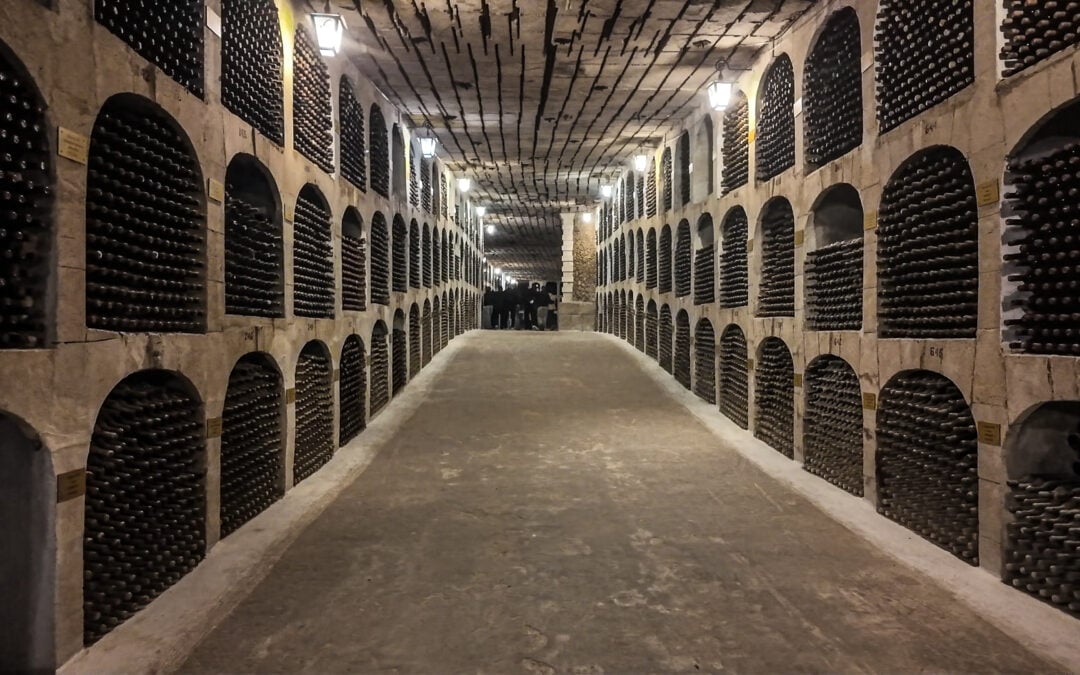
If I were to ask you where the world’s largest wine collection is stored, I’d be very surprised if your first answer was ‘Moldova’. But on the outskirts of Chisinau, buried deep beneath fields that have nurtured vines for millennia, you’ll find as many as 2 million bottles of wine stored in a vast network of limestone tunnels stretching for a staggering 200 kilometres. This is the Mileștii Mici Winery, a place that holds the history, and perhaps the future, of Moldovan wine within its cavernous stone passageways.
Since 2005, Guinness World Records has recognised Mileștii Mici’s wine collection as the world’s largest. Incredibly, the world’s largest wine collection is also stored within the world’s largest underground winery. The tunnels are so extensive that to explore this underground city, visitors are transported below ground on electric land trains.
When I recently visited Chisinau in early 2026, I had to see this subterranean world for myself. So I planned a trip into the countryside surrounding the Moldovan capital. I discovered how Moldovan winemaking traditions stretch back well over 5000 years, how the Soviets carved galleries from disused quarries, and how modern geopolitics (ahem, Russia) threatened to destroy Moldova’s winemaking industry entirely.
Keep reading and learn how I visited Mileștii Mici Winery, and how you can too.
Table of Contents
What’s it like visiting Mileștii Mici Winery?
You can watch the YouTube video from my trip to Mileștii Mici Winery, or scroll down for my guide:
Mileștii Mici Winery Quick Facts
What is Mileștii Mici: The world’s largest underground winery, home to 2 million bottles of wine
Location: Mileștii Mici, Ialoveni District, Republic of Moldova
How to get there: A 20-minute Bolt or taxi ride away from central Chisinau
Opening hours: Monday-Thursday 10 am-6 pm, Friday-Sunday 10 am- 7 pm
Costs: Guided tours of the underground vaults start from 350 Moldovan Lei (approx £15)
Recommended Tour: Mileștii Mici Underground Tour tasting & Wine Labyrinth
What and where is Mileștii Mici Winery?
“Mileștii Mici winery opened in 1969,” I was told by Valeria, who leads tours of the underground vaults, after we’d descended into the dark caverns stretching beneath the Moldovan countryside. “These were old quarries before. They quarried the limestone to rebuild Chisinau after the Second World War, then discovered how the empty tunnels had the perfect conditions for ageing and storing wine.”
As we stood below ground, next to oaken barrels of Pinot Noir and Cab Sav which line the galleries, Valeria explained how the limestone tunnels stretch for a staggering 200 kilometres. Around 50 kilometres’ worth of tunnels are currently used for storage, sitting at a depth of anywhere between 40 and 80 metres. Temperatures are a fairly constant 12-14 degrees Celsius, while the humidity hovers around 80%.
During the Soviet era, when the tunnels were excavated, winemakers discovered that these conditions were perfect for storing wine, and from 1969 onwards, Mileștii Mici’s collection grew and grew until Gorbachev tried (unsuccessfully) to limit drinking in the USSR (more on that below).
The winery itself is located just 20 minutes or so from central Chisinau, in the village of Mileștii Mici. The surrounding fields are devoted to viticulture, as they likely have been for millennia, but above ground, there’s little sign of what truly awaits you in this subterranean mega-city.
Indeed, the tunnels are so expansive that the only way to explore them is by vehicle. Parked outside the entrance to the tunnel system were bicycles and buggies, but as I’d signed up for a group tour followed by a tasting, I’d be touring through on an electric land train.
After finding a seat on the land train, we slowly trundled into the damp underground. The long tunnels are lined with oaken barrels where Mileștii Mici’s wines are aged before they’re bottled. There’s even a man-made waterfall, which Valeria pointed out was an effort to keep the humidity constant. When we made it to the entrance of the ‘Golden Collection’ – where some 2 million bottles of wine, and counting, are stored – she gave us a brief history of Moldovan winemaking.

Moldova’s extraordinary winemaking history
It’s not unfair to say that Moldovan wine isn’t exactly well known outside of the former Soviet Union, that is. Moldova is only the 11th largest wine producer in Europe, although in recent years, it’s seen its exports (particularly to the European Union) rise markedly. But Moldova’s modest winemaking reputation hides the fact that wine has been produced in the region for millennia.
The land between the Prut and Dniester Rivers, which largely corresponds to modern Moldova, has cultivated vines since ancient times. Various estimates suggest this tradition could date back anywhere between 5000 and 7000 years. Wine was exported along the Black Sea trade routes to ancient Greece, and later Roman influence in Dacia ensured that winemaking techniques were refined and new export markets established.
Viticulture flourished during the medieval era, particularly under the Principality of Moldavia, where winemaking was prized. These traditions survived the Ottoman era, and then, when Moldova came under Russian rule in the early 19th century, new international grapes – including the likes of Merlot and Cabernet Sauvignon – were introduced with great success. Russian aristocrats sponsored and funded Moldovan wineries. The Russian Tsars loved Moldovan vintages, and Moldova’s winemaking industry grew to become one of the largest in the Russian Empire.
Moldova would fall under the yoke of Bolshevism, and following the Second World War, the Soviets industrialised the republic’s vineyards. Quality was sacrificed for quantity, and Moldovan wine was exported and consumed in vast quantities across the USSR. Then, in 1969, Mileștii Mici was opened, but the story was far from over.
The Golden Collection
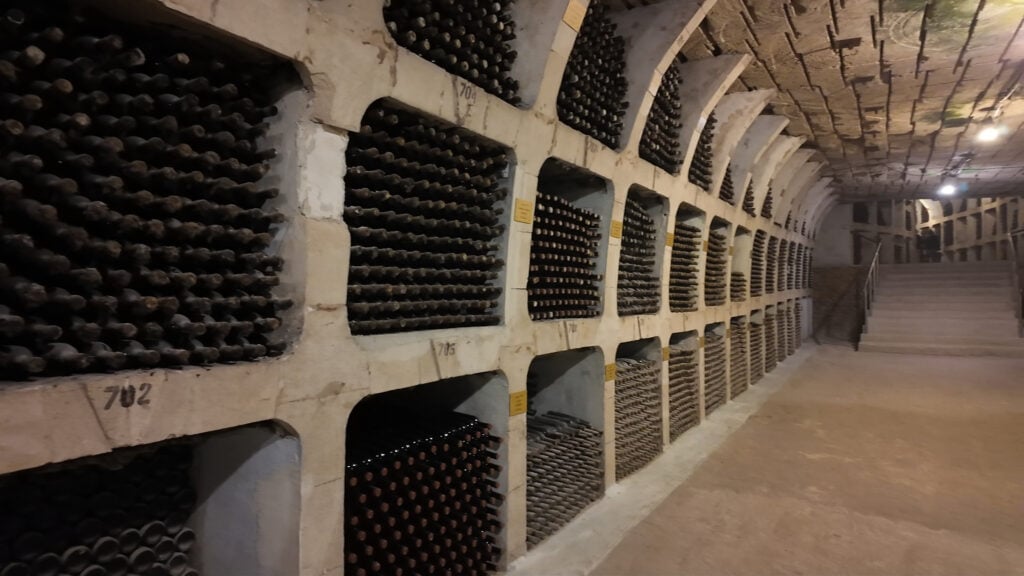
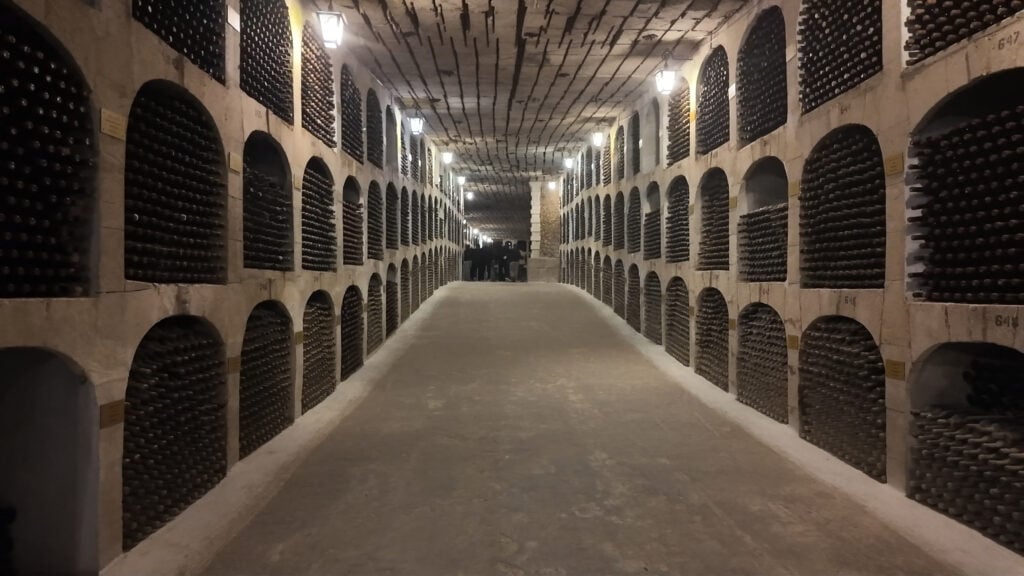
I’ve seen various figures thrown around when it comes to the overall size of Mileștii Mici’s wine collection. “There are 2 million bottles,” I was told by Valeria, as we entered the prestigious vaults of ‘The Golden Collection’, where bottles of wine are physically stored underground in the vast vaults of the winery. “The oldest bottle dates back to 1969, when Mileștii Mici first opened.”
UNESCO, which recognises both Mileștii Mici and Cricova – another underground winery of similar size, which is also located near Chisinau – as World Heritage Sites, estimates there to be over 1.5 million bottles stored here. Since 2005, Mileștii Mici has held the Guinness World Record for ‘Largest wine cellar by number of bottles’. Guinness estimated there to be 1.5 million bottles, although it also notes how this number is increasing year-on-year.
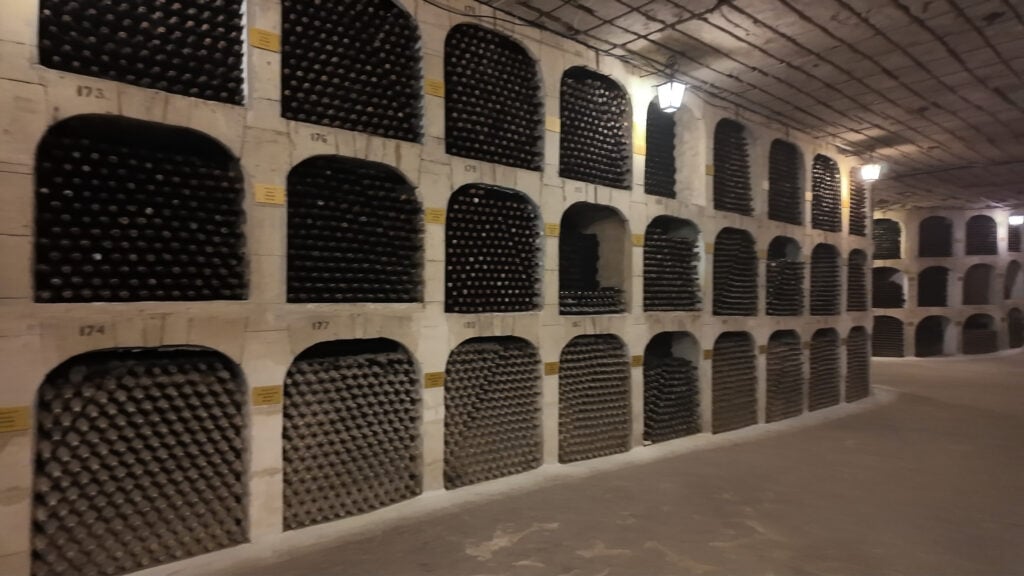
These bottles, often dusty and well-aged, are carefully stacked in grooves carved into the limestone rock. They’re frequently turned, and presumably, they’re rarely removed. As we walked through the galleries, past row upon row of wine bottles, Valeria explained how wine collectors from countries as varied as Belarus, Ukraine, China, and Cameroon all store their prized vintages here. She said that it costs around 500 Euros per year for the service, and you need a minimum of 50 bottles to be stored. The vast majority, around 70%, are red wines. 20%, I was told, are white, and the remainder are dessert wines.
Mileștii Mici also stores its own bottles here, and we were shown into a room where sommeliers will sample the vintages to decide which are ready, or which are best, for sale. Inside the room, there’s a statue, appropriately enough, dedicated to Bacchus, the Roman god of wine.
The secret Soviet-era vaults within Mileștii Mici
“During Gorbachev’s era,” Valeria said, as she showed our group to what was seemingly a dead-end vault. “The Soviets tried to destroy all the wineries and bottles. But workers here saved fifty thousand bottles, which they stored in a secret vault underground.”
That secret vault still lies behind the Golden Collection’s galleries. Peering through a crack in the limestone rock that’s been left unsealed, I could see a vast, now empty chamber, where legend has it Mileștii Mici’s sommeliers defied the orders of Gorbachev, who was attempting to stamp down on alcoholism across the Soviet Union by imposing bans on drink and drink production in the 1980s.
When the Soviet Union collapsed in the 1990s, a newly independent Moldova faced fresh and often bewildering challenges. The wine industry continued largely exporting to former Soviet countries and to Russia, but in 2006, the Russians banned imports of both Moldovan and Georgian wines. The Russians, who imported around 80% of Moldova’s total wine production, claimed this was for reasons of health and safety. The reality: it was a political move attempting to thwart Moldova and Georgia’s increasingly close ties with the European Union.
The industry was almost devastated, but as Valeria said, this also forced Moldovan wine producers to focus on quality and to find new markets. Fast forward, and the vast majority of Moldovan wine is now exported to the European Union, where it’s slowly making a new name for itself.
Tasting Mileștii Mici’s finest wines
At the end of the hour-long tour through the limestone galleries, we were driven to an underground tasting vault where I had the chance to try Mileștii Mici’s finest wines first-hand.
I’d paid extra for an optional tasting package, which cost 800 Moldovan Lei (approx £33) and included a red, white and dessert wine, alongside generous plates of Moldovan cheese.
It was excellent value, not least because everyone was also given a bottle of red to take home (I drank that later on the Soviet-era sleeper train from Chisinau to Bucharest), but because the wines truly were excellent. There are several options for tasting packages, ranging from the basic package I sampled, right up to a 7-wine tasting complete with a full dinner spread of Moldovan culinary specialities.
Either way, there’s little sense in taking the tour without trying at least a few glasses of wine at the end. On the way out, you’ll pass through the gift shop on your return to the surface, where, of course, you can purchase yet more bottles of excellent value Moldovan wine. All in all, a tour of Mileștii Mici Winery is certainly reason enough on its own to visit Moldova, and it makes for a simple day trip from Chisinau.

Read more: 14 Best Things To Do In Chisinau, Moldova
How to visit Mileștii Mici Winery
If my trip has inspired you to make the journey to Moldova yourself, then here’s a practical guide on visiting Mileștii Mici:
How can I travel to Mileștii Mici from Chisinau?
Mileștii Mici Winery is located on the outskirts of Chisinau, so it really does make for an excellent half-day trip from the capital. I personally took a Bolt here from the city. It’s super easy to find drivers in Chisinau; the journey took around 20 minutes, and it cost 150 Moldovan Lei (approx £6.50).
The problem with Bolt, however, is that it doesn’t work quite so well outside of Chisinau. After the tour, we tried ordering a Bolt to pick us up, but there weren’t any available. Even though several Bolts dropped other tourists off at the entrance, we couldn’t seem to land one on the app. Luckily, the team at Mileștii Mici ordered us a local taxi from the village, which swiftly arrived and took us back to Chisinau. This was on the metre, and again it cost around 150 Moldovan lei.
If you can, it might be wise to pre-book a taxi through your hotel in Chisinau. This is certainly advisable if you don’t have time to wait on the other end. The other option is organising a tour through GetYourGuide or similar. These are far more expensive, but will provide guaranteed transport there and back.
Do I need to book a tour to visit Mileștii Mici Winery?
To visit the Golden Collection, explore the underground tunnels and enjoy a tasting, you need to pre-book a tour in advance. You can do this on the Mileștii Mici Winery website, where there’s an updated list of tour packages, times and prices. There are several tours a day, each lasting at least 1 hour (plus extra time for tastings). Tours are available in multiple languages (Romanian, English and Russian), so make sure to pick the right one. I booked my tour about a week in advance, but on the day, it seemed to be fully booked.
These guided tours take you on a land train ride through the tunnels, accompanied by a tour guide. You’ll see all the highlights and end with a tasting (if you’ve booked one). You’ll also receive one bottle of wine to take home.
Technically, you can rock up to Mileștii Mici Winery, but there’s no guarantee that you’ll get on a tour. There is however a wine bar and gift shop above ground, which are open to the public.

Mileștii Mici vs Cricova
Moldova has two of the world’s largest underground wineries, both of which are inscribed under UNESCO World Heritage Status. I can’t comment on Cricova, which is located to the north of Chisinau, but I’ve heard it’s a similar setup and experience. The difference is that Mileștii Mici is technically the largest and is home to the largest wine cellar (which is why I chose Mileștii Mici over Cricova). If you’ve been to Cricova, why not let me know in the comments how it was?
There you go! The complete guide to visiting Mileștii Mici winery in Moldova! Let me know how your trip went in the comments below.